JIO MOVIES

Wednesday, April 28, 2021

New world news from Time: To Solve Disordered Migration, Governments Need to Think About Climate Change


Mexican president Andrés Manuel López Obrador made a tangible proposal at last week’s U.S.-led climate summit, a rarity in the world of climate geopolitics. He called on President Joe Biden to finance an expansion of Mexico’s mass tree-planting program, called “Sowing Life,” across Honduras, Guatemala and El Salvador (which make up the “Northern Triangle” region just south of Mexico). The program would pay farmers in those countries to plant trees, which, he said, could help alleviate rural poverty and convince potential undocumented migrants to stay home. The U.S., he added, could offer six-month work visas for those who participated in Sowing Life for at least three years, “giving order to the flow of migration.”

It was a bold idea, coming from a controversial populist leader with a dubious track record on environmental policy. It hit on an enticing number of U.S. priorities, though: in January Biden signed an executive order mandating the infusion of climate action across foreign policy. He has also pledged to spend $4 billion to tackle the causes of migration from the Northern Triangle and, as my colleague Brian Bennett reports , one of his long-term goals is to open more pathways to legal immigration to the U.S. Plus, politicians in general really like to plant trees.

But it turned out that the U.S. had dismissed López Obrador’s idea before he formally proposed it. At a pre-summit press briefing on April 20 one U.S. official said that while the Biden government supports nature-based climate solutions, it is “not focused on the intersection between the two issues…. This is not a conversation for us about immigration. It’s a conversation about climate change.”

The U.S. is right to be wary of financing Sowing Life. In 2019, its first year of operation, only 80 million of the 575 million planned trees were planted. Investigative reporting by Bloomberg found that in some regions, the program incentivized farmers to cut down forests in order to re-plant the cleared land. Local journalists warn the funding structure leaves the program open to corruption—an endemic problem in the region where López Obrador proposes expanding. According to Néstor Génis, an investigator at Ethos, a Mexican public policy think tank, the program could end up a long-term success if its leaders learn from their mistakes, and U.S. technical support could help. But, he says, “there are no indicators so far that this program is a success in Mexico and should be exported to other countries.”
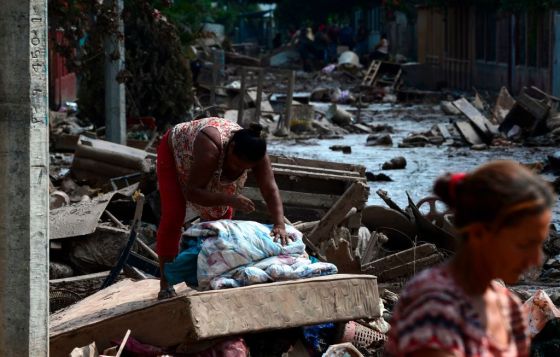
HONDURAS-WEATHER-HURRICANE-IOTA
Orlando SIERRA – AFP/Getty ImagesWomen try to recover belongings after the passage of Hurricane Eta through Omonita in El Progreso, Honduras, on November 15 2020,

Whatever you think about the Sowing Life program specifically, though, the U.S.’ assertion that climate and immigration need to be dealt with separately is confounding. Many of those now arriving at the southern border are fleeing the impact of Hurricanes Eta and Iota, two devastating storms that hit Central America last November. For years, others have emigrated because climate change is intensifying droughts and destroying agricultural livelihoods in the so-called “Dry Corridor,” a tropical dry forest region that runs from Guatemala to Costa Rica.

Indeed, the Biden Administration’s own state department doesn’t seem to agree with what its representative said at that April 20 press briefing. Asked to clarify, a state department spokesperson told me on April 26 that the U.S. is “closely cooperating” with Mexico on migration strategies, including looking at “the link between the effects of climate change and increased migration, as well as effective models for alternative labor pathways.” On April 27, Vice President Kamala Harris announced a $310 million package of humanitarian aid for the Northern Triangle, specifically targeting food insecurity and the impacts of drought.

Immediately after the November storms, Guatemala’s president said the region urgently needed aid to stop “crowds of Central Americans going to other countries in search of a better life.” International financing to help vulnerable regions adapt to climate change is sorely lacking, and as extreme weather events and agricultural disruption become increasingly common, climate-vulnerable developing countries will likely increase their demands on wealthy countries to take responsibility for their massive contribution to climate change.

When it comes to the U.S., taking responsibility may mean both rethinking immigration policy—Biden has already commissioned a report on “options for protection and resettlement” of climate refugees—and making climate adaptation a constant focus for U.S. spending abroad. Analysts say the Biden Administration has “a chance to respond to both climate change and migration in Central America in one fell swoop,” by investing in renewable energy and reforestation programs in the region.

Mexico hasn’t given up on Sowing Life, promising to make the program a focus of a May 7 meeting between López Obrador and Vice President Harris. Whether or not that succeeds, Mexico’s flawed proposal at last week’s summit demonstrates the need for the U.S. and other donor countries to engage with communities and environmentalists–not just governments–in places where they want to drive climate action. The success of that engagement will be decisive for the millions of people who may, over the next few years, have to choose between a rapidly changing home, and an uncertain path away.


A version of this story first appeared in the Climate is Everything newsletter. If you’d like sign up to receive this free once-a-week email, click here.

New world news from Time: Why The COVID-19 Variants Spreading in India Are a Global Concern


As the numbers of COVID-19 cases and deaths in India continue to mount, public health officials are carefully watching yet another looming threat: the appearance of mutations that could be making the virus circulating there more infectious or more capable of causing severe disease.

Scientists believe that the variants of SARS-CoV-2 responsible for this second wave of cases in India already include at least two mutations that make them more dangerous. These mutations are already familiar to COVID-19 experts. One is found in a variant first identified in South Africa, while the other is part of a variant believed to have emerged from California. Researchers believe that these two mutations may, respectively, make it easier for the virus to infect human cells, and to evade the protection provided by immune cells like antibodies. According to the latest data from the public genome database GISAID, 38% of genetically sequenced samples from India collected in March contain the two mutations—scientists have labelled this the B.1.617 variant.

“It’s taken us by surprise,” says Dr. Ravindra Gupta, professor of clinical microbiology at the University of Cambridge who has studied the SARS-CoV-2 virus and its variants, including the one emerging from the UK, B.1.1.7. that appears to spread more easily among people, and is now the dominant strain of virus causing new infections in the U.K. and the U.S. “The steep, rapid increase in cases is really quite startling. It’s probably the result of relaxed social distancing, a lot of social gatherings including religious gatherings, also combined with new variants.”

Sumit Chanda, director of the immunity and pathogens program at Sanford Burnham Prebys Medical Discovery Institute in San Diego, Calif., describes the situation in India as a sort of perfect storm. “People became complacent, and politicians were declaring victory over the virus—a mission accomplished mentality,” he says. “They decided to have one of the biggest religious ceremonies and mass gatherings of humans in the world—I saw pictures and no one was masked, and it was happening in highly dense population centers. Then you have the emergence of a variant and that’s what is really driving what is happening over there.”

Chanda says it’s likely that the mutations evolved from the excessive replication that’s occurring among the burgeoning infections in India. With every new person the virus infects, it has a new opportunity to frantically copy its genome. And in its rush to duplicate its genome, the virus makes mistakes—repeatedly—and those mistakes sometimes end up making the virus fitter and stronger. Those “mistake” versions become variants that start to outcompete and dominate other, less fit viruses.

For the people the virus infects, that could also mean a viral variant that causes more severe, and even deadly disease.

Following India’s first wave of COVID-19 in the spring of 2020, health officials locked down the country, but it turned out that people who were infected didn’t get that sick; in fact, the case fatality rate was low. That led to a proportion of the population developing some level of natural immunity to the virus. But that proportion wasn’t enough to provide anything close to herd immunity, so when social restrictions were lifted in May 2020 and people began congregating again, it created the perfect conditions for the virus to mutate. “Once you let your guard down, these variants basically have more field to play on,” says Chanda. “When you have unmitigated spread, then that’s more fuel you give to the virus to make these mistakes, and the stronger viruses will pop out.”

Chanda, Gupta and others are also investigating whether another phenomenon might be at work driving the severe disease in India. It’s possible that people previously infected with SARS-CoV-2, but who did not have a severe case of COVID-19, might get even sicker if they are reinfected—a dynamic seen with some other disease-causing viruses, like dengue.

Researchers refer to this phenomenon—in which people are infected and only partially successful in fighting the virus so they continue to harbor the infection for months rather than days—as “suboptimal protection.” In one such patient, who was infected for about four months, Gupta documented the steady changes the virus made as it mutated to become better and better at evading any immune responses directed against it. “Some people can’t clear the virus—they get infected and they can’t get rid of it—so they have some immunity to the virus but the virus learns to live with their immune system, and makes mutations to adapt. And those same mutations adapt again when they infect someone else.”

It’s not clear if this is happening in India, but it could explain why so many people are getting sick so quickly. In any case, from a public health perspective, it makes sense to assume this is what’s going on—the response should be to urge people to take preventive actions like wearing masks and social distancing even if they have been infected in the past, which would be beneficial during an epidemic whether or not the virus is spreading among the previously infected. “We should be planning for the worst case scenario and assume people are being reinfected. There’s not much lost by over-calling it, since the rate of infection is already so high,” says Gupta.

As countries including the U.K. and U.S. start to send supplies and aid, India’s experience should serve as a warning for the world. The Indian variant has already been reported in the U.K. and Japan, and samples from the U.S. also appear to contain the variant’s genetic fingerprint, so building up immunity quickly through mass vaccination is more critical than ever.

“India is a cautionary tale that if we open up bars willy nilly, this could happen to us,” says Chanda. “We are at the point now [in the U.S.] where we have suboptimal immunity because people are still being vaccinated.” That is, this is exactly the time that the virus has enough room to maneuver, and genetically adapt to evade vaccines. The key to preventing that from happening? Get more people vaccinated.

New world news from Time: Asia’s Economies Are Set to Rebound From COVID-19 Faster Than the U.S. or Europe – If They Can Step Up Vaccine Rollouts


Asia’s reward for effectively tackling the COVID-19 pandemic will be some of the fastest economic growth in the world in 2021.

But, economic success could be thwarted by the region’s sluggish vaccine rollout and deadly new waves of COVID-19—especially the catastrophic outbreak that is claiming thousands of lives every day in India.

That is the promise—and the warning—of the Asian Development Bank’s 2021 economic forecast for the region, released Wednesday.

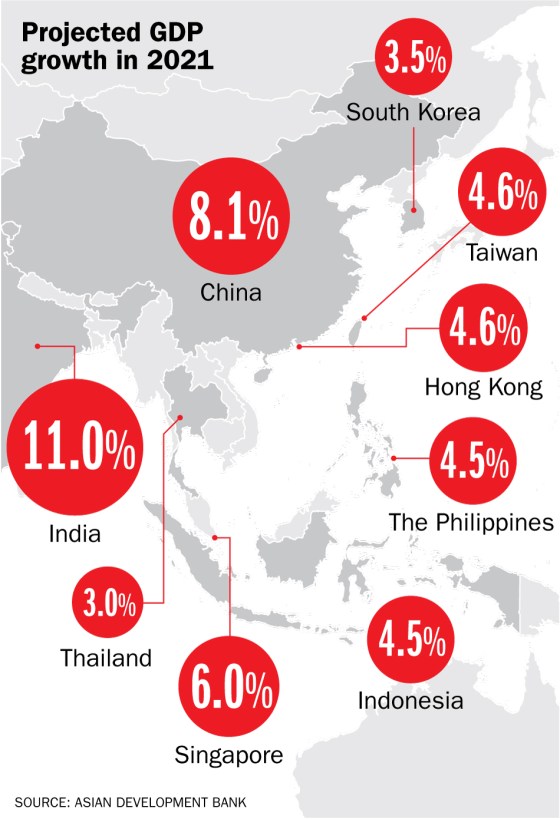
The 46 economies across the Asia-Pacific region, excluding Japan and Australia, are projected to rebound from the pandemic and grow by 7.3% this year.

Compare that with growth forecasts of 6.2% in the U.S. and 3.8% in the Eurozone, and Asian nations look likely to emerge much faster from the economic devastation caused by COVID-19.

Asian Development Bank 2021 Economic Growth Projections
Lon Tweeten–TIMEThe 46 economies across the Asia-Pacific region, excluding Japan and Australia, are projected to rebound from the pandemic and grow by 7.3% in 2021, according to the Asian Development Bank.

The ADB, whose largest shareholders are Japan and the U.S., is a development bank that invests in projects meant to promote economic growth and reduce poverty across the Asia-Pacific region.

The severe outbreak in India drives home the urgency of governments across the region stepping up their lagging vaccination programs, says Abdul D. Abiad, the director of the ADB’s macroeconomic research division.

“It’s a race now between vaccinations/herd immunity, and new variants that can emerge and spread,” he tells TIME by email. “If the latter win, the recovery will lose traction.”

Although many places in Asia did relatively well at combatting the coronavirus, the region is now lagging in vaccine rollouts. The U.S. has administered at least one dose of a COVID-19 vaccine to more than 40% of its population, according to Oxford University’s Our World in Data project. In the wealthy city-state Singapore, a leader in Asia’s vaccination race, just over 20% of people have had a shot. In the financial hub Hong Kong, fewer than 12% of people have received a dose. Meanwhile, in India less than 9% of people, and in South Korea and Indonesia less than 5% of people, have had their first shot. Less than 2% of the population has received a first jab in Japan, the Philippines and Thailand—which are all battling new COVID-19 waves of their own.

The reasons for this are complex, but Abiad says right now the biggest challenge to vaccination programs in Asia is the supply of doses. “Demand from people wanting to get vaccinated exceeds available vaccine supply in most countries,” he says.

Read More: ‘I Pray for My Nani.’ The Survivor’s Guilt of Watching India’s COVID-19 Catastrophe Unfold From Afar

Other risks to Asia economic recovery include geopolitical tensions between the U.S. and China, limited vaccine effectiveness and long-term educational losses from school closures.

Divergent recovery paths

The region’s economic recovery will be uneven, as some countries battle fresh outbreaks. The ADB forecasts India to grow about 11% in 2021, though that figure is already at risk with the latest outbreak, says Abiad.

India-COVID-surge
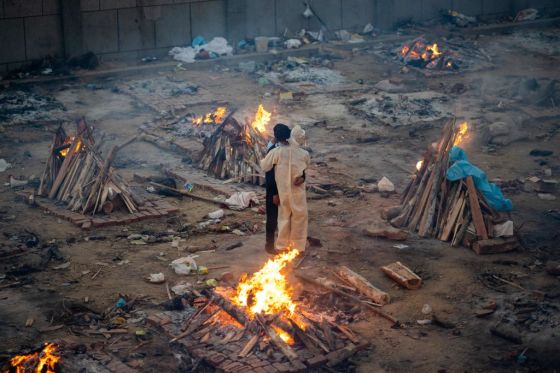
Jewel Samad—AFP/ Getty Images Family members embrace each other amid burning pyres of victims who lost their lives due to the coronavirus at a cremation ground in New Delhi on April 26, 2021.

Read More: As the U.S. Moves Toward Post-Pandemic Life, COVID-19 Is Still Devastating the World—Especially India

India is reporting more than 300,000 new cases a day with daily deaths nearing 3,000 (and the number of unofficial cases and deaths is believed to be much higher). Desperate pleas for oxygen and intensive care beds for sick patients have been circulating on social media platforms.

Still, in a press briefing, Yasuyuki Sawada, ADB’s chief economist, said India’s huge growth forecast remains “achievable.” He added: “India’s vaccine rollout is going well.”

Countries like China and Vietnam, which have strong exports of manufactured goods and kept COVID-19 under control have “been able to ride the wave of rising global demand,” Abiad says. China is forecast to grow more than 8% this year, after expanding by 2.3% in 2020—a year when many Asian countries fell into recession.

But even small COVID-19 outbreaks can threaten economic recovery. A COVID-19 surge of a few thousand cases a day in Thailand could set back the country’s plan to reopen tourism.

The Pacific region, also highly dependent on tourism, is expected to perform the worst of any area in the Asia-Pacific, with growth at a modest 1.4%. Travel bubbles are expected to help some countries start to recover.

“Tourist-dependent economies in the Pacific and elsewhere face a slow road back,” the ADB said.

New world news from Time: ‘I Pray for My Nani.’ The Survivor’s Guilt of Watching India’s COVID-19 Catastrophe Unfold From Afar


The Sunday before last, I awoke to find that my aunt in India had added me to a WhatsApp family chat, titled “Mama”—her mother-in-law, my 91-year-old-grandmother. I scrolled through dozens of messages from my extended family, trying to figure out what had happened. At last I came to the dreadful news: “…Mama is positive.”

My grandmother, who raised me, had tested positive for COVID-19. Her daughter-in-law, in turn, who lived with her was positive, as was her daughter, my cousin. A few days before, my great uncle, my grandmother’s last surviving sibling, had died of the virus. He, like my grandmother, had received one shot of the AstraZeneca vaccine. But it was not enough to protect him. On the seventh day, his oxygen levels and blood pressure plummeted, and his weak heart gave out. We did not dare tell my grandmother, for fear that grief would further compromise her health.

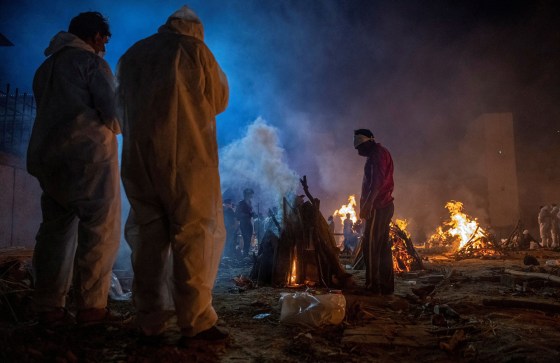
It is hard to exaggerate the hell India has become in these past two weeks. The country is reporting more than 350,000 new cases a day with daily deaths nearing 3,000. A New York Times report over the weekend, with interviews at hospitals and crematoria, showed “an extensive pattern of deaths far exceeding the official.” An epidemiologist at the University of Michigan described it as “a complete massacre of data,” believing the actual figure of deaths to be between two and five times more than what is being reported. To open any line of communication, be it social media or messaging apps, is to be inundated with heartrending pleas for oxygen, therapeutic drugs (like Fabiflue and Remdesivir) and ICU beds. Everyone I know knows someone who is sick, or dead. The sick can’t get into hospitals, the dead can’t get into crematoria. The atmosphere in my hometown of New Delhi is bordering on apocalyptic.

Read More: How Countries Around the World Are Helping India Fight COVID-19—and How You Can Too

We, who grew up in India and moved away—India’s diaspora numbers around 18 million worldwide—are in a lesser circle of hell than our beloved friends and family back home. But it is a kind of hell for us, too—one of helplessness and guilt. If last year was defined by everyone feeling themselves in the same boat, this year is quickly emerging as a year of hideously bifurcated realities. As New York returns to relative normalcy, I find myself paralyzed by the bad news out of India. Immigration, and the feelings of exile and homelessness that can result, are hard at the best of times. One is forever balancing multiple societies in one’s head (and heart) at the same time, while still trying to forge a new life in a new place that one is lucky to be in. But when one’s adoptive home thrives, even as the home country flounders, a kind of survivor’s guilt kicks in. Far from being able to enjoy one’s safety, the temptation is to cling to one’s loyalties.

People cremate the body of a victim of the coronavirus disease at a crematorium ground in New Delhi on April 24
Danish Siddiqui—ReutersPeople cremate the body of a victim of the coronavirus disease at a crematorium ground in New Delhi on April 24

The news about my poor old Nani, alone and sequestered, in the care of a nurse, brought out a wave of anger in me. It is Prime Minister Narendra Modi’s hubris, incompetence and callousness that are largely responsible for this catastrophic second wave. In January, at a virtual Davos, he prematurely proclaimed victory over COVID-19, holding India up as an example to others, describing it as “the world’s pharmacy.” He then allowed the lion’s share of India’s vaccines to be sent overseas (the country is among the world’s largest manufacturers) while proceeding to hold vast in person election rallies and permit religious gatherings of several million to go ahead. India, which had merely got lucky the first time round, went into a death spiral. The country was woefully unprepared, woefully unvaccinated.

Read More: ‘This Is Hell.’ Prime Minister Modi’s Failure to Lead Is Deepening India’s COVID-19 Crisis

As people lay their dead out in the street, as they did in plague-stricken 17th-century London, what Modi cares most about is Modi. He has instructed Twitter, Facebook and Instagram to take down posts critical of his government. His High Commissioners have written furious letters to foreign publications who dare fault his handling of the pandemic. There is no more telling indication of the mental atmosphere he has engendered than the fact that not a single major Bollywood actor or cricketer has the courage to come forward and commiserate with their country engulfed in grief. For even to offer comfort to the sick and dying is to tarnish the cult of Modi. In TIME, on the eve of his re-election two years ago, I wrote: “…as India gets ready to give this willful provincial, so emblematic of her own limitations, a second term, one cannot help but tremble at what he might yet do to punish the world for his own failures.”

There is no pleasure in being right. What matters now is that the country of my origin learn its lesson from my adoptive home: when you elect a narcissist demagogue to the highest office in the land, there is untold death and suffering. When you boot him out, there can be life again. In the meantime, India will keep a long painful vigil, even as cremation, the rite by which the soul is released through fire of its mortal envelope, becomes a luxury. Everyone is praying for someone.

I pray for my Nani—and for India.

New world news from Time: What Biden’s Recognition of Armenian Genocide Means to Armenian-Americans


Armenian-Americans have welcomed President Joe Biden’s historic declaration that the killing and deportation of up to 1.5 million Armenians during World War I constituted genocide as a long overdue yet positive step in reckoning with history.

“We affirm the history,” Biden said on April 24. “We do this not to cast blame but to ensure that what happened is never repeated.” The statement, released on Armenian Genocide Remembrance Day, marked the first time a U.S. president formally equated the violence against Armenians with atrocities on the scale of those committed in Nazi-occupied Europe.

Turkey, the modern-day successor of the Ottoman Empire, adamantly denies that the killings were part of a systematic plan to erase the Armenian population that would meet the U.N. definition of genocide. Authors and journalists in Turkey who use the term “genocide” have been prosecuted for “insulting Turkishness.”

The U.S. is now among 30 countries, including France, Germany and Canada, that have formally recognized the Armenian genocide, according to the Armenian National Institute. Other U.S. allies, including the U.K. and Israel, have not. Turkey’s foreign ministry said that Biden’s statement “opened a wound” in Ankara-Washington relations and “deeply injured the Turkish people,” in a statement, according to the Financial Times.

But to Armenians, the statement was a long-awaited acknowledgement of an atrocity against their people they believe has been persistently understated. Over a century later, the events are “primary identity markers” of Armenians around the world, says Mary Kouyoumdjian, a 38-year old Armenian-American composer based in New York. “It means we are constantly looking to the past. I think my generation experiences survivor guilt,” she says.

During World War One, the Germany-aligned Ottoman government accused the Armenians of treachery after suffering a heavy defeat at the hands of Russian forces. On April 24, 1915, Ottoman authorities arrested several hundred Armenian leaders and intellectuals, an event seen by many as the beginning of the massacre. One and a half million Armenians were killed by soldiers and police, or died of starvation and exhaustion in long, cruel marches to concentration camps in what is now northern Syria and Iraq. About 500,000 Armenians survived, and many eventually emigrated to Russia, the U.S. and elsewhere. Turkey claims that 300,000 Armenians died of disease and hunger as they were being deported.

Kouyoumdjian’s great-grandparents and grandparents fled to Lebanon, where they mostly settled in Beirut’s Armenian quarter Bourj Hammud, a neighborhood that was established as a refuge for Armenians escaping the genocide. But during the Lebanese civil war that began in 1975 and lasted until 1990, Kouyoumdjian’s parents were forced to leave, gaining refuge in the U.S. Kouyoumdjian, 38, is the first in her family to be born in America.

For 20 years, her work has involved composing music that integrates documentary and interviews with survivors of war and genocide. She said she can’t find a way to separate herself from the people telling their stories. “A lot of these interviews become a form of processing my own family history,” she says.

Kouyoumdjian has mixed feelings about Biden’s announcement. She says it was a “relief” and has given her a “great deal of faith in the president’s commitment to human rights, over political complexities”. But she says it should have come sooner. “The fact that it took 106 years for the U.S. to say something has meant a lot of damage to Armenians around the world”, she says. The wounds of the past will not fully heal, in her view, until Turkey acknowledges the genocide.

Simon Maghakyan, a human rights activist and lecturer in international relations at the University of Colorado, Denver, says that Biden’s statement was an important step in “healing the Armenian community’s intergenerational trauma”. During the genocide, his great-grandfather, who served in the Ottoman army in World War I, fled to Syria, where he met his future wife, an Armenian refugee. They later settled in Soviet Armenia, where Maghakyan’s parents were born. In 2003, Maghakyan’s family moved to the U.S.

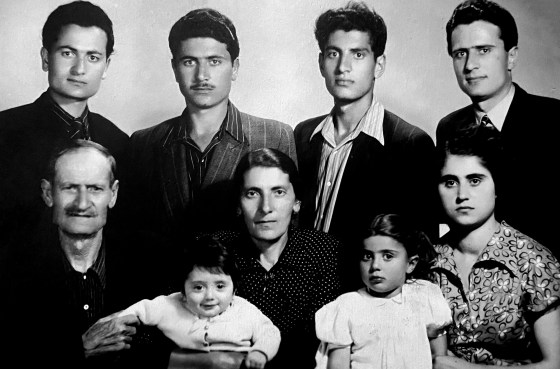
Simon Maghakyan’s paternal family in 1955.
Courtesy Simon MaghakyanSimon Maghakyan’s paternal family in 1955, all gone now. On the left, holding Maghakyan’s baby father, are his great-grandparents who had survived the Armenian Genocide in Urfa (modern Turkey).

But Maghakyan says that the U.S. recognizing the Armenian genocide “only truly matters” if the White House takes strong measures to help protect the security Armenians, including in Nagorno-Karabakh, a disputed region over which Armenia and Azerbaijan recently went to war. “Recognizing Armenia’s past without its present is not meaningful,” he adds.

Last fall, in the latest in a series of conflicts in the region, Armenian forces clashed with Azerbaijan, which was backed politically and militarily by its ally Turkey, killing at least 6,000 Azerbaijani and Armenian soldiers. Sarah Leah Whitson, former director of the Middle East and North Africa Division at Human Rights Watch, wrote that propaganda in Turkish media said that Ankara would “finish off” what it started in 2015. “Many Armenians were truly convinced that Turkish forces would attempt to slaughter the population of Armenia as well,” she wrote.

A Russian-brokered peace deal that ended the six-week war required Armenia to hand control of large swathes of territory over to Azerbaijan. Many ethnic Armenians left the territories that were set to be handed over to Azerbaijan and according to the region’s nominally independent Armenian-backed government, over 40,000 Karabakh Armenians have been permanently displaced.

Maghakyan believes the U.S. should adopt measures providing humanitarian relief to displaced Karabakh Armenians, and sanctioning Turkey and Azerbaijan for their involvement in the recent conflict in Nagorno-Karabakh.

Many Armenians have also had to come to terms with what Kouyoumdjian and Maghakyan call “cultural genocide”. Maghakyan has been researching the erasure of Armenian culture for the past 15 years. His 2019 research, conducted independently, indicated over the past 30 years cultural and religious Armenian artefacts were covertly and systematically destroyed in an alleged Azerbaijani campaign to eliminate indigenous Armenian culture in Nakhichevan, an Azerbaijani exclave between Armenia, Iran and Turkey. Maghakyan and Sarah Pickman, a co-author of the report, found that the destroyed artifacts included 5,840 cross-stones, the earliest of which date back to the 6th century, despite a 2000 UNESCO order demanding their protection.

The genocide happened 106 years ago but Maghakyan says it is still a “modern issue” for many Armenians. He wishes the U.S. recognized the Armenian genocide and accounted for it long before he was born. “We might have overcome the intergenerational trauma by now,” he says.

Tuesday, April 27, 2021

New world news from Time: Here’s Why Chloé Zhao’s Oscars Win Was Censored in China


Nomadland director Chloé Zhao made history at the 2021 Oscars Sunday evening, becoming the first woman of color to win Best Director in the institution’s 93-year history. She is only the second woman ever to pick up the accolade, after Kathryn Bigelow’s win for The Hurt Locker in 2010.

In her acceptance speech, Zhao spoke of her memories growing up in China and recited part of a poem called the Three Character Classic in Mandarin. The excerpt translates as “people at birth are inherently good.”

The Oscars win, which preceded Nomadland’s wins for Best Picture and Best Actress (for Frances McDormand), follows a similar scoop at the Golden Globes for Zhao, who was born in Beijing, and became the first Asian woman to collect that award too. On the same night, Yuh-Jung Youn became the first Korean actor to win an Academy Award for her role in Minari. Both of these firsts are milestones, especially given Hollywood’s long history of fetishizing, stereotyping or excluding Asian women in front of the camera—in more than nine decades, the Academy Awards has recognized fewer than two dozen Asian performers in acting categories, and when it has done so, has rewarded roles that trade on harmful tropes or stereotypes.

While Zhao’s success has been praised as a major step forward in representation behind the camera this awards season, efforts to celebrate these firsts appear to have been dampened in China, where reports of censorship and media silence emerged Monday.

Why China is censoring Chloé Zhao and Nomadland

Chinese state media had initially referred to Zhao as “the pride of China” after her Best Director win at the Golden Globes last month. But an unearthed 2013 interview with the American publication Filmmaker Magazine, in which Zhao talked about growing up as a teenager in China and referred to it as “a place where there are lies everywhere,” soon sparked backlash and reports of censorship on social media sites, as well as critiques of Zhao from social media users, reported the New York Times.

Since its initial publication, the 2013 article has been “edited and condensed,” according to a note on Filmmaker Magazine’s website, with the widely-quoted portion referring to Zhao’s upbringing in China now omitted.

China’s two biggest state-run media outlets, CCTV and Xinhua, did not carry reports of Zhao’s win as of Monday afternoon, although the state-run paper Global Times and its editor Hu Xijin did tweet their congratulations to the director. “Chloe Zhao wins Best Director,” a hashtag on the popular microblogging site Weibo, was censored and inaccessible for users, the Associated Press reported Monday. The AP also reported that searches for “Nomadland” and “Zhao Ting” (Zhao’s name in Chinese) were banned on film app Douban, while a news article about Zhao’s win on the hugely popular Chinese networking app WeChat was deleted. According to Reuters, organizers of a live-stream event in Shanghai were unable to watch the ceremony as planned Monday morning, as the organizer said access to his Virtual Private Network was blocked for nearly two hours.

What has Chloé Zhao said about China?

As a 14-year-old in the 1990s, Zhao moved to the U.K. to study at boarding school.

“A lot of info I received when I was younger was not true, and I became very rebellious toward my family and my background. I went to England suddenly and relearned my history,” said Zhao in the original version of the 2013 Filmmaker Magazine article, according to an archived version still available online. “Studying political science in a liberal arts college was a way for me to figure out what is real. Arm yourself with information, and then challenge that too.”

In conversation with Moonlight director Barry Jenkins for Variety, Zhao spoke of growing up in China with a love of manga, saying that “we didn’t have movies when I was growing up, not the same way that you guys had access to films, but I did have just cabinets and cabinets of Japanese manga. I just devoured them.”

Zhao later moved to the U.S. and studied political science before enrolling in New York University’s Tisch School of the Arts’ graduate film program in 2010, where Spike Lee was her professor. Her first feature film, Songs My Brother Taught Me, was shot on a Native American reservation in South Dakota and released in 2015, and her follow-up The Rider, a contemporary Western drama, was released in 2017.

She has not forgotten her roots, however. In a recent profile in New York Magazine, Zhao spoke of her travels around the world and her Chinese heritage, describing northern Chinese people as “my own people” and of being “from China.” She has also spoken before about feeling like an outsider and how that interacts with her filmmaking, telling the Telegraph that “wherever I’ve gone in life, I’ve always felt like an outsider. So I’m naturally drawn towards other people who live on the periphery, or don’t live mainstream lifestyles.”

Zhao was praised on Twitter for speaking Mandarin in her acceptance speech. “If this win helps more people like me get to live their dreams, I’m so grateful,” Zhao told reporters backstage Sunday night, adding that her parents had always told her “who you are is enough, and who you are is your art.”

China’s history of Hollywood censorship

Sunday night’s awards ceremony wasn’t screened in China.

The Hong Kong station TVB, which has broadcast the Oscars every year since 1969, said it would not do so this year for commercial reasons. The decision fueled speculation that it was politically motivated and raised concerns around freedom of expression, exacerbated by the nomination of Do Not Split, a 35-minute film by Norweigan director Anders Hammery about the Hong Kong protests shortlisted for the Best Short Subject Documentary. The filmmakers of the winning documentary short Colette nodded to Hammer in their acceptance speech, saying that “the protesters in Hong Kong are not forgotten.”

China’s economic power and middle class have grown exponentially over the past two decades, and so has Beijing’s ability to dictate to foreign filmmakers eager to reach Chinese audiences. This year’s Oscars ceremony is not the first Hollywood cultural export that the Chinese government has censored or sought to control. As TIME reported in 2017, “pleasing Chinese audiences—and a Chinese central government hyperallergic to criticism—is now part of the Hollywood formula.”

A report last year by PEN America suggests that control has only increased, saying that filmmakers around the world are having to make difficult decisions about the “content, casting, plot, dialogue, and settings” of their movies to appease Chinese investors and gatekeepers. The report suggested that the 2016 Marvel film Dr. Strange whitewashed the Tibetan character The Ancient One (ultimately played by Tilda Swinton) “for fear of jeopardizing the film’s chances in China,” and that the Taiwanese flag was removed from the trailer for the Top Gun sequel, originally due in 2019 but postponed to 2021. The report also refers to Quentin Tarantino’s Once Upon a Time in Hollywood, which was pulled from China’s movie release schedule a week before release in 2019, reportedly due to the film’s unflattering depiction of Bruce Lee.

It’s unlikely that Nomadland, an independent film following modern-day nomads in America’s Midwest, would have found wide audiences in mainland China. But Zhao’s next feature, the Marvel blockbuster The Eternals, might pose more questions upon its release in November.

New world news from Time: U.S. to Share 60 Million Doses of AstraZeneca Vaccines Amid Global COVID-19 Surge


The U.S. announced Monday it would share its entire supply of AstraZeneca’s Covid-19 vaccine with other countries and readied an aid package for India, as President Joe Biden pivots to ramp up U.S. pandemic assistance to the rest of the world.

The decision would make as many as 60 million vaccine doses available for export in coming months, if they clear a federal safety review. The plan represents a shift for Biden, who has hesitated to give vaccine doses and materials to other countries while focusing on ensuring Americans are vaccinated first.

“Given the strong portfolio of vaccines that the United States has already authorized and that is available in large quantities — including two two-dose vaccines and one one-dose vaccine — and given AstraZeneca is not authorized for use in the United States, we do not need to use AstraZeneca in our fight against Covid over the next few months,” White House Press Secretary Jen Psaki told reporters on Monday.

The announcement reflects growing pressure the U.S. has faced to share its vaccine supply with other countries, such as India, that have seen surges of Covid-19 infections or struggled to jump-start their vaccination drives. It also shows that the Biden administration is confident in its vaccine stockpile, especially after sites over the weekend were cleared to resume administering the Johnson & Johnson one-dose shot.

Biden in a phone call Monday pledged his full support to Indian Prime Minister Narendra Modi, who is combating the world’s largest surge of infections. The assistance package offered to India, which includes raw materials for vaccines and therapeutics, reflects Biden’s belief that the pandemic won’t end unless the U.S. offers assistance to other countries, according to a senior administration official.

Sharing Doses

No final decisions have been made on which countries will receive the AstraZeneca doses, a senior administration official said. The U.S. previously loaned 4.2 million AstraZeneca shots to Mexico and Canada, the only Covid-19 vaccine doses it has shared so far. AstraZeneca has not sought Food and Drug Administration authorization for its vaccine, but has already manufactured millions of doses in the U.S. under a federal contract.

About 10 million AstraZeneca doses that have already been produced could become available for export in the next several weeks if they pass FDA checks for product quality, a senior administration official said. Another 50 million doses are still in production and could be ready to ship by May or June if they pass the inspections, according to the official.

Any decision to send doses to India could increase pressure from other countries that have been trying to get the U.S. to share shots but so far have been rebuffed. Mexico and Canada have asked for a larger allotment of AstraZeneca vaccines.

“We’re in the planning process at this point,” Psaki said.

More than 1.02 billion vaccine doses have been administered worldwide as of Monday, enough to fully vaccinate 6.7% of the global population, according to Bloomberg’s Vaccine Tracker.

Still, the vaccination campaign has been uneven, with wealthier countries generally ahead of less wealthy ones in giving shots. Just 5.3% of India’s population has been fully vaccinated as of Monday compared with 36% in the U.S.

The need for vaccines in India has become even more acute as it has become the global epicenter of the pandemic. The country recorded 352,991 new virus cases on Sunday, the fifth consecutive day it set a world record for a single-day increase in Covid-19 infections.

The spike brought the total number of cases in India to 17.3 million, second in the world only to the U.S. More than 195,000 people have died there as of Sunday, though public-health experts believe the death count is likely higher.

The U.S. announced Sunday it would send raw materials for vaccines to India and step up funding for the country to manufacture more doses. Ventilators, therapeutics, rapid testing kits and personal protective equipment will be sent as well, the White House said. While vaccine doses were not included, the U.S. is sending a supply of remdesivir, an anti-viral drug used to treat hospitalized Covid-19 patients, a senior administration official said.

India’s Surge

In their Monday phone call, according to senior administration officials, Biden and Modi pledged to work closely together to combat the virus and Biden promised steadfast support for the people of India amid the surge in Covid cases.

The aid package includes oxygen and related supplies, with the U.S. looking at sending oxygen generation systems. A team of experts from the Centers for Disease Control and Prevention is being sent to India to assist public-health officials there as well, the White House said.

Anthony Fauci, Biden’s chief medical adviser, said Monday that “everything is on the table right now for discussion” when he was asked why the U.S. had not given away doses of the AstraZeneca vaccine, including to India.

“I think we can safely say that the issue of doses of vaccine, particularly the AZ vaccine, are certainly under active discussion. And I would say, safely, that everything is on the table right now for discussion,” Fauci said at an event hosted by the Harvard School of Public Health.

The U.S. has used wartime powers and contractual clauses to give its orders priority — meaning that there are, as of now, no known U.S.-made doses that have gone to any buyer other than the U.S. government.

A spokesman for AstraZeneca said the company can’t comment on specifics but said the doses were part of AstraZeneca’s supply commitments to the U.S. government, and decisions to send supply to other countries would be made by U.S. officials.

Earlier this month, Bloomberg reported that the U.S. stockpile of the AstraZeneca vaccine had grown to more than 20 million doses, part of a total of between 80 million and 90 million doses in some stage of production for the U.S. order.

Biden signaled last week that the U.S. was considering loaning more, but said that won’t happen until there is enough supply.

“We don’t have enough to be confident to give it — send it abroad now,” he said. “But I expect we’re going to be able to do that.”

–With assistance from Jennifer Jacobs, Jeannie Baumann, Riley Griffin and Suzi Ring.

New world news from Time: Afghanistan Faces a ‘Make-or-Break Moment,’ U.N. Chief Says

UNITED NATIONS — Warning that Afghanistan is facing “a make-or-break moment,” the United Nations chief on Monday urged the world t...