The clash between the European Union and drugmaker AstraZeneca Plc over Covid-19 vaccine delays temporarily descended into chaos on Wednesday before the two sides confirmed that a crunch call to resolve the standoff will take place.
Earlier on Wednesday, an EU official said the company had pulled out of the planned talks with the European Commission and government representatives. The official, who asked not to be named, said Astra executives had sent an email on Tuesday evening withdrawing “because there are too many moving parts.” The cancellation was disputed by Astra, and the EU subsequently said discussions were back on.
The contradictory statements were just the latest twist in a saga that erupted late last week when Astra warned of delays at a production plant in Belgium. That was followed by public disagreement over contract terms, accusations of blame, and even threats to put limits on vaccine exports. The latest confusion — which pushed the life-and-death issue into the realm of farce — is also an echo of the broader disorganization that’s marked the EU’s rollout of coronavirus shots so far.
Iskra Reic, Astra’s Executive Vice-President for Europe and Canada, will take part in the meeting, where the EU wants to get more details about the delay to the rollout of shots. Governments are desperate to speed up the vaccination, as it’s proved sluggish so far, and also keen to avoid taking the blame.
The on-off status of the call emerged after Astra Chief Executive Pascal Soriot used an interview with European newspapers to deflect responsibility to the EU. He said the company has a so-called best-effort agreement that doesn’t specify a quantity. That’s because the EU insisted on receiving the AstraZeneca vaccine about the same time as the U.K. despite putting in its order three months later.
A key part of the disagreement is the use of vaccines produced in U.K. factories. Speaking on condition of anonymity, an EU official said that Soriot’s claim that the U.K. has priority on vaccines from British plants doesn’t exist in the contract.
The EU’s vaccination pace is lagging way behind the U.S. and the U.K. in terms of the share of its population inoculated, according to Bloomberg’s global tracker. Soriot said that once Astra gets EU regulatory approval — expected within days — it will ship at least 3 million doses immediately, with a target of 17 million by February.
That should help Europe accelerate vaccinations and get economies closer to exiting damaging lockdowns that have crippled industries and caused growing discontent. Soriot suggested he understands that the situation is difficult for leaders across Europe, where Brussels has coordinated a vaccine-buying program.
“Everybody is getting kind of a bit, you know, aggravated or emotional about those things.” he said in the comments published in La Repubblica and other newspapers. “But I understand because the commission is managing the process for the whole of Europe.”
In an effort to alleviate supply shortages, French drugmaker Sanofi said it has agreed to help produce more than 125 million doses of the shot Pfizer Inc. developed with Germany’s BioNTech SE. That shot, and one by Moderna Inc., are already authorized for use.
Sanofi will provide BioNTech access to its production sites in Frankfurt starting this summer, it said in a statement Wednesday. The goal is to accelerate efforts to package and distribute the vaccine, which needs to be kept at ultra-cold temperatures.
The United Kingdom passed the grim milestone of 100,000 COVID-19 deaths on Tuesday, only the fifth country to record a six-figure death toll, and by far the smallest.
With the entire country still under a national lockdown to slow the spread of the virus, Prime Minister Boris Johnson said Tuesday it was “hard to compute the sorrow” of the statistic in a national address, and offered his “deepest condolences to anyone who has lost a loved one.”
Half of the more than 100,000 deaths in the U.K. have come since November, when the virus, which reached low levels in the population over the summer, began spreading with renewed speed. In December, scientists identified a new variant of the virus in the U.K. that was up to 70% more transmissible. On Jan. 22, Johnson said that variant could be up to 30% more deadly, too.
The U.K.’s death toll is lower than the U.S.’s 425,000, but its population is only one-fifth of the size of America’s andits per capita death rate is higher by nearly 13%, according to data from Johns Hopkins University. The only countries in the world that are worse affected than the U.K. in terms of per capita death rate are the small European nations of San Marino, Belgium and Slovenia.
Prime Minister Johnson said that the U.K. government “did everything we could” to control the spread of the virus, but the opposition Labour Party and public health experts say that his government is responsible for a list of avoidable failures.
The opposition Labour Party said the government had made “monumental mistakes” in its handling of the pandemic. “I just don’t believe that the government did do everything [they] could,” Labour’s health spokesman, Jonathan Ashworth, told the BBC on Wednesday.
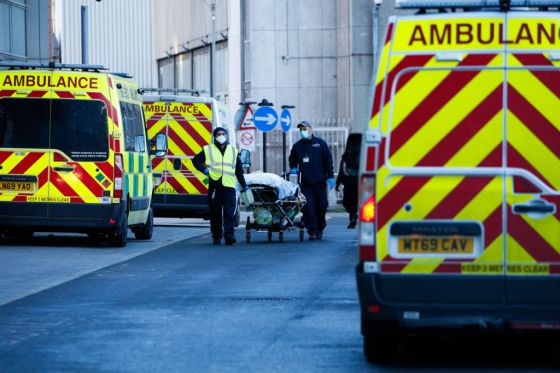
NurPhoto via Getty Images—David Cliff/NurPhotoMedical staff wheel a patient on a stretcher to an ambulance outside the emergency department of the Royal London Hospital in London, England, on January 25, 2021.
Why is the U.K.’s death toll so high?
The U.K. has had two main surges of COVID-19 infections. At one stage at the beginning of the pandemic it was the worst-hit country in Europe in terms of infections and deaths; now, at the peak of the second wave, it again has more total cases and deaths than any other European country.
In recent weeks, the government has blamed the new variant of the virus for the rise in cases and in deaths. “In fighting the old variant of the virus, our collective efforts were working and would have continued to work,” Johnson said on Jan. 4, announcing a new national lockdown. “But we now have a new variant of the virus.”
Others blame the government itself. “It all comes down to failed leadership,” says John Ashton, a former regional director of public health in England, who points out that Britons make up a greater percentage of the world’s dead from COVID-19 than they did in the flu pandemic of 1918-19. “We’ve got modern medicine, and we’ve actually done worse than we did in 1918,” he says. “It looks as though we’re in a worse position than America.”
Ashton points to a list of factors including historic under-investment in public health. But chief among the reasons for the U.K. being hit so hard is the government’s immediate response, he says. The government’s public health messaging was inconsistent, it lost the public’s trust through aseries of scandalsand policyU-turns, and more recently, it failed to take decisive measures during the Christmas period.
In December, the government announced — and then partially backtracked on — plans to relax rules to allow families to meet for five days to celebrate the Christmas holiday, even as the new variant was spreading around the country. “In the third week of December, Johnson was still banging on about having five days of Christmas, against all advice,” says Ashton. “We were in a worse position with the new variant than we needed to be. We’ve been reaping the reward, if you will, about being slack in the lead-up to Christmas.”
Is the U.K.’s lockdown working?
On Jan. 4, Prime Minister Johnson announced the U.K. would have to go into another national lockdown because of the surge in infections across the country, driven by the more infectious new variant.Schools are closed, and most non-essential businesses and workplaces are out of bounds. People are only allowed to leave their homes for a limited list of reasons including exercise and buying food.
The data suggest it is working. Three weeks into that lockdown, the number of new cases per day has dropped from a peak of more than 81,000 on Dec. 29 to 39,000 on Jan. 19, the most recent day for which complete figures are available.
Still, public health experts say, extended national lockdowns are a last-resort measure that should be avoidable if governments introduce targeted restrictions early. So, the lesson from public health experts: yes, the lockdown is working. But the lockdown — and the grim milestone of 100,000 deaths — could have been avoided altogether.
How much worse could the U.K.’s COVID situation get?
There are signs that the worst has passed. According to the U.K. government’s COVID-19 data, the average daily death toll is leveling off at around 1,000 per day, and the number of new daily cases is now on a downward trend, from a peak at the turn of the new year.
Another reason for optimism is the U.K.’s advanced vaccine rollout, which the government has regularly pointed to as a source for hope amid a long, dark, winter lockdown.
Britain has administered more vaccines per capita than any other country in the world except for Israel and the United Arab Emirates, according to Oxford University’s Our World in Data project. More than 6.8 million people in the U.K. (some 10% of the population) have now received the first dose of a COVID-19 vaccine, according to government figures.
“We are now rolling out the biggest vaccination program in our history,” said Johnson on Jan. 4. “By the middle of February, if things go well and with a fair wind in our sails, we expect to have offered the first vaccine dose to everyone in the four top priority groups.” That includes all individuals aged 70 and over, frontline healthcare workers and nursing home residents and staff.
But experts caution against the British government placing all its hope in vaccines alone. Ashton, the former regional public health director, says that the risk of the virus evolving faster than vaccine research means that ground-level public health investment is needed too, something that successive Conservative governments have neglected in the U.K.
“We have to be very careful,” Ashton says. “You can’t put too much weight on vaccines saving us in this. You’ve got to simultaneously strengthen your public health, because it requires the classic stuff of rooting out outbreaks through local knowledge and local action. This virus is going to be with us for the foreseeable future, and it’ll keep evolving, we’ll keep getting new strains. We can’t just think science will save us. We have to do the public health stuff.”
NEW DELHI — Tens of thousands of farmers massed on tractors outside the Indian capital as the nation celebrated Republic Day on Tuesday in the backdrop of agricultural protests that have grown into a rebellion and rattled the government.
The tractor rally overshadowed the Republic Day celebrations in New Delhi even as the annual military parade was scaled down because of the pandemic.
A thin crowd assembled beside the ceremonial Rajpath boulevard in New Delhi to watch a display of the country’s military power and cultural diversity. People wore masks and adhered to social distancing as police and military battalions marched along the parade route. Several states displayed their floats to present their culture and the army showcased its latest equipment during the parade.
Republic Day marks the anniversary of the adoption of the country’s constitution on Jan. 26, 1950.
Meanwhile, thousands of tractors, decorated with Indian and farm union flags, lined up on the outskirts of New Delhi, ready to swarm the Indian capital.
Heavy contingents of police in riot gear patrolled the routes farmers were to take during the rally.
“We want to show Modi our strength,” said Satpal Singh, a farmer.
The protests were set off by new agricultural laws Parliament passed in September. Prime Minister Narendra Modi’s government insists the laws will benefit farmers and boost production through private investment, but farmers fear cartelization and commercialization of agriculture will devastate their earnings.
Farmers first tried to march to New Delhi in November but were stopped by police. Since then, unfazed by overnight chilly winter temperatures they have hunkered down with food and fuel supplies and threatened to besiege the capital until the farm laws are repealed.
The government has offered to amend the laws and suspend their implementation for 18 months. But farmers insist they will settle for nothing less than a complete repeal.
MOSCOW — Allies of jailed Russian opposition leader Alexei Navalny, who faces years in prison, called for new protests next weekend to demand his release, following a wave of demonstrations that turned out tens of thousands across the country in a defiant challenge to President Vladimir Putin.
Mass rallies took place Saturday in over 100 cities in what observers said was the largest outpouring of anger in years, and Navalny’s supporters urged protesters to keep up the pressure.
Navalny strategist Leonid Volkov tweeted Monday for more demonstrations on Jan. 31 in “all Russian cities. … For Navalny’s freedom. For our freedom. For justice.”
During Saturday’s protests, over 3,700 people were detained, according to OVD-Info, a human rights group that monitors political arrests. The group said the number was a record in its nine years of work. More than 1,400 detentions occurred in Moscow alone — also a record, according to Russian media.
Some of those detained were released without charges, but many others faced court hearings. In Moscow, courts have handed jail terms ranging from seven to 15 days to at least 30 detainees and fined 64 others.
Authorities also launched more than a dozen criminal investigations in Moscow, St. Petersburg and other Russian cities on charges of inciting unrest, involving minors in illegal activity, violence against police, blocking roads, hooliganism and damaging property. Navalny’s team said Russia’s Investigative Committee also is probing violations of virus-related restrictions.
Dozens of Navalny associates in various cities were detained in the days before the protests. Alexander Peredruk, senior partner of the Apologia of Protest legal aid group involved in the defense of over 1,000 detainees from the Saturday protests, called the authorities’ response “unprecedented.”
Navalny, an anti-corruption campaigner and Putin’s fiercest critic, was arrested Jan. 17 as he returned to Russia from Germany, where he had spent nearly five months recovering from nerve-agent poisoning that he blames on the Kremlin. Russian authorities deny the accusations.
He was ordered jailed for 30 days but faces years in prison, with authorities accusing him of violating the terms of a suspended sentence in a 2014 conviction for financial misdeeds. Navalny has said the conviction was politically motivated.
White House press secretary Jen Psaki urged the immediate and unconditional release of Navalny, as well as those who were detained in the crackdown. Psaki did not say when President Joe Biden plans to speak to Putin.
Biden was asked if he would put sanctions on the people involved in the poisoning and arrest of Navalny and what that means for prospects of the extension of the New START nuclear arms treaty with Russia.
“I find that we can both operate in the mutual self-interest of our countries as a New START agreement and make it clear to Russia that we are very concerned about their behavior,” he said, whether it involved Navalny or some other issue.
The European Union’s foreign ministers on Monday condemned his arrest and the detention of thousands at the protests. “The Council considered it completely unacceptable, condemned the mass detentions, and the police brutality over the weekend,” EU foreign policy chief Josep Borrell said after chairing the meeting in Brussels.
The ministers, however, stopped short of weighing new sanctions. Borrell said “there has not been any concrete proposal on the table,” but added that the ministers are “ready to act, depending on the circumstances.”
In Russia, public indignation was further fueled by an investigation Navalny’s team released into what they called “Putin’s palace.” A two-hour video posted on YouTube on Jan. 19 alleged a lavish “palace” was built for Putin on the Black Sea through an elaborate corruption scheme. It has since received over 86 million views.
The Kremlin has denied the estate had anything to do with the president. Speaking to students via video on Monday, Putin himself addressed the allegations, calling them an attempt to “brainwash our citizens” and saying that “none of what is mentioned there as my property has never belonged, and doesn’t belong, to me or my close relatives.”
Asked about Saturday’s protests, Putin said that “all people have the right to express their point of view within limits, outlined by law.” He referenced the Jan. 6 attack on the U.S. Capitol and said that those taking part in it were facing “between 15 and 25 years, as if for domestic terrorism.”
“They also came out with political slogans. But outside the law. Why should everything outside the law be allowed here? No,” Putin said.
The Russian protests and crackdown appeared to have further strained Russia-U.S. relations.
U.S. State Department spokesman Ned Price on Saturday condemned “the use of harsh tactics against protesters and journalists” and urged authorities to release Navalny and “all those detained for exercising their universal rights.”
Kremlin spokesman Dmitry Peskov accused Washington of interfering with Russia’s “internal affairs,” after the U.S. Embassy in Moscow put a warning on its website detailing times and places of rallies in different Russian cities and urging U.S. citizens to avoid them.
On Monday, Russia’s Deputy Foreign Minister Sergei Ryabkov lodged a protest to the U.S. Ambassador John Sullivan in connection to “social media posts in support of unlawful rallies” by the U.S. Embassy in Moscow.
The ministry said it has also deemed the statement of the U.S. State Department spokesman “inappropriate.”
___
Associated Press writers Vladimir Isachenkov in Moscow, Zeke Miller and Josh Boak in Washington and Lorne Cook in Brussels contributed.
Usually this week in January, global leaders, policymakers and heads of business would be heading to the Swiss Alps to share ideas on how to solve the world’s great challenges.
Sadly, the major challenge facing the world — the COVID-19 pandemic — has also prevented delegates from assembling at the World Economic Forum as they usually would. However, WEF is instead forging ahead with a virtual summit, the Davos Agenda, to offer a platform for leaders in a range of fields to convene, debate, and learn from one another.
TIME’s editors are participating in a number of events, including a panel on stakeholder capitalism hosted by TIME editor-in-chief Edward Felsenthal. Joining him are World Economic Forum co-founder and chair Dr Klaus Schwab, Belgian Prime Minister Alexander De Croo, Beninese musician and activist Angelique Kidjo, economist Mariana Mazzucato, and PayPal’s chief executive Dan Schulman
Ahead of the panel, we asked three of the delegates to share their proposed solutions for a major problem facing society:
Angelique Kidjo: Close the financial gender gap in Africa
It’s 2021, and economies all around the world are suffering following a global pandemic that has disrupted them to their core. And while citizens and governments are trying to find financial short-term band-aid solutions to stop the bleeding, we know we will feel the repercussions of this for a while.
But the truth is, there are some who have always been left out of the national – and global – economies: African women. On a continent that is a vibrant source of creative and innovative ideas, half of the population has little to no chance of actually being able to participate in building – or rebuilding economies.
African SMEs have restricted access to bank loans (financing gap is estimated to be of $155bn). And on top of that, African women continue to be excluded from financial services, because of cultural, social, and political norms. In sub-Saharan Africa, only 37 percent of women have a bank account, compared with 48 percent of men, a gap that has only widened over the past several years.
African financial institutions need to learn how to listen, trust, and support African women. The potential is there, and it is their right to be active participants in an economy that believes in them, respects them, and treats them fairly. Ghana has the third highest rate of women-owned businesses in the world, at 36.5%. We have success stories that can inspire us to lift others up too.
We need to close the gender gap in African markets and economies, and we need to do it now. Financial institutions, entrepreneurs, and governments need to step it up to ensure that tomorrow’s economies don’t reproduce today’s mistakes. African women need – and want in – economies in which they can participate, and thrive. Their economic empowerment is the cornerstone of the continent’s future success.
Kidjo is a musician and UNICEF Goodwill Ambassador
Mariana Mazzucato: Turn school meals into the backbone of a green economy
The world is increasingly afflicted by inequalities, which the Covid pandemic is only exacerbating. Gig economy workers have found themselves out of jobs with no protection. The digital divide means that underprivileged students in lockdown get even more behind. And queues are forming in underfinanced foodbanks, with images recalling those from the great depression.
In this difficult time, goals like those around the Green New Deal are treated like luxuries that need to take the back seat until more urgent matters are solved. But this is a false tradeoff. How we solve immediate problems—from foodbanks to the digital divide– can be embedded in long-term planning, with a green deal at its center.
In the U.K., a Manchester United footballer Marcus Rashford has been campaigning to get the government to make sure poor children have free school meals during lockdown and during holiday periods, and to increase the quality of these meals, which have been outsourced to companies seemingly less interested in nutrition than profits. This is critical, as many children are missing out on a healthy school meal, which have been proven central to eliminating health and educational inequalities for the whole family.
But imagine if, instead of simply funding school meals, they became the focus for a green deal strategy. The value chain for those meals— agriculture, production, distribution and consumption—should be part of a carbon neutral, healthy and sustainable strategy. Students and their families could get involved in designing the school meals policy, studying sustainable food systems in their science and social studies courses, and also playing an active role in monitoring whether the outcomes are tasty.
Bringing such goals to the center of how government procures key public services, from school meals to public transport, will be key to turning the notion of stakeholder value into a tool not only for corporate governance but for how public-private partnerships can become more purposeful at the center of a re-energised welfare state. This is not a daydream – it can, and does, happen in the real world. I am working with both Vinnova, the Swedish innovation agency, and the London Borough of Camden, on creating systems-change ‘missions’ with food as a focus.
Covid presents us with a desperate situation that needs immediate measures to protect health and incomes. But we cannot forget that more serious environmental crises loom around the corner. We must be bold. We must solve the immediate with ambition, designing into the solutions the foundations to make tomorrow a better world. Otherwise ‘building back better’ is only a slogan, and we risk remaining stuck in a world that perpetuates one crisis after another: economic, health and climate.
Mazzucato is Professor in Economics at University College London, and the author of Mission Economy: A Moonshot Guide to Changing Capitalism which appears this week
Dan Schulman: Create an economy that works for everyone
Closing the racial wealth gap and building racial equity remains one of the most pressing and persistent challenges of our time. We have not made meaningful progress in the decades since the Civil Rights movement of the 1960s. The impact of the pandemic has continued to illuminate the inequities in our economy and further widened the gaps. In fact, approximately 41% of Black-owned businesses closed between February and April 2020, nearly double the national average of 22%. This is the result of many interlocking issues, including limited access to capital and equity financing, systemic discrimination, and educational and infrastructure disparities. And it is completely unacceptable.
Business leaders have a moral obligation to help address the inequitable economic underpinnings that for far too long have created barriers to opportunity and growth in Black communities. Doing so is not only essential to the post-pandemic recovery, but also to our progress in building a more just and inclusive world for future generations.
This urgent work will require intentional and sustained effort from many leaders, and the PayPal community is committed to doing our part with a range of partnerships and investments in Black-owned businesses. We all have the opportunity to contribute to meaningful change in our communities and in our country, and we have never had a more important moment to stand up for the values we share. Closing the racial wealth gap is critical to fixing capitalism and making it work for everyone. Imagine the progress we can make if we all come together and do our part to build a more inclusive and equitable society.
President Joe Biden will continue to restrict travel to the U.S. from the U.K., Ireland and 26 countries in Europe, and will extend the ban to South Africa, to slow transmission of Covid-19, said a White House official familiar with the plan.
The latest ban would prevent most non-U.S. citizens from entry if they have recently been in South Africa, where a new strain of the virus has been identified. It’s unclear how long the restrictions will continue.
The Trump administration on Jan. 18, two days before Biden’s inauguration, announced a plan to wind down restrictions on travelers from a number of countries starting Jan. 26, when arrivals to the U.S. would need to have tested negative for the virus.
At the time, White House press secretary Jen Psaki said the incoming administration planned to block the move, saying on Twitter that “this is not the time to be lifting restrictions on international travel.”
With the pandemic worsening, and more contagious variants emerging around the world, this is not the time to be lifting restrictions on international travel.
“In fact, we plan to strengthen public health measures around international travel in order to further mitigate the spread of COVID-19,” Psaki tweeted.
The U.S. is warily viewing new coronavirus strains that have originated in South Africa and Brazil, as well as one recently identified in the U.K. that’s more transmissible and potentially more harmful.
Reuters first reported the U.S. plan to ban travel from South Africa for most non-U.S. citizens, citing officials with the Centers for Disease Control and Prevention.
Starting Monday, all passengers arriving in the U.S., including citizens, will be required to get a viral test for the coronavirus within three days of their departure, and to provide written documentation of a negative result.
The CDC, in an order issued on Sunday, eliminated an option for airlines or other aircraft operators with flights from countries that lack testing capacity for Covid-19 to apply for two-week waivers from the order.
“With the U.S. already in surge status, the testing requirement for all air passengers will help slow the spread of the virus as we work to vaccinate the American public,” the CDC said in its order.
The U.K. warned this weekend that coronavirus vaccines may be less effective against new variants of the disease, such as those now being found in South Africa and Brazil, making stricter border controls justified.
Scott Gottlieb, the former head of the U.S. Food and Drug Administration, said Sunday that it’s highly likely the South African variant is already in the country.
“I feel fairly confident that it is here and we’re just not detecting it yet,” Gottlieb said on “Face the Nation Extra” on CBS.
(Updates with CDC guideline on waivers from eighth paragraph.)
(MEXICO CITY) — Mexican President Andrés Manuel López Obrador said Sunday he has tested positive for COVID-19 and that the symptoms are mild.
Mexico’s president, who has been criticized for his handling of his country’s pandemic, said on his official Twitter account that he is under medical treatment.
“I regret to inform you that I am infected with COVID-19,” he tweeted. “The symptoms are mild but I am already under medical treatment. As always, I am optimistic. We will all move forward.”
López Obrador, 67, has long been criticized for not setting an example of prevention in public. He has rarely been seen wearing a mask and continued to keep up a busy travel schedule taking commercial flights.
Lamento informarles que estoy contagiado de COVID-19. Los síntomas son leves pero ya estoy en tratamiento médico. Como siempre, soy optimista. Saldremos adelante todos. Me representará la Dra. Olga Sánchez Cordero en las mañaneras para informar como lo hacemos todos los días.
He has resisted locking down the economy, noting the devastating effect it would have on so many Mexicans who live day to day.
Early in the pandemic, asked how he was protecting Mexico, López Obrador removed two religious amulets from his wallet and proudly showed them off.
“The protective shield is the ‘Get thee behind me, Satan,’” López Obrador said, reading off the inscription on the amulet, “Stop, enemy, for the Heart of Jesus is with me.
In November, Tedros Adhanom Ghebreyesus, head of the World Health Organization, said that “Mexico is in bad shape” with the pandemic and urged its leaders be serious about the coronavirus and set examples for its citizens.
He didn’t name López Obrador, but said: “We would like to ask Mexico to be very serious.”
“We have said it in general, wearing a mask is important, hygiene is important and physical distancing is important and we expect leaders to be examples …” he added.
At the start of the pandemic López Obrador was criticized for still leaning into crowds and giving hugs. The eternal campaigner, López Obrador’s style of politics has always been very hands on and personal. As the pandemic grew he began limiting attendance to his events and maintaining his distance from supporters.
Despite his age and high blood pressure, as well as undergoing surgery after a heart attack, López Obrador said he wouldn’t jump the line for a vaccination. His concession appeared to be regular testing. In a country that only tests people with significant symptoms, López Obrador gets tested once a week.
At his age and with his existing health conditions López Obrador’s turn for a vaccine could still be weeks away as the country still works to vaccinate front line health workers.
As of Sunday night, Mexico had given nearly 630,000 doses of vaccine.
Mexico has registered nearly 150,000 COVID-19 deaths and more than 1.7 million infections. Hospitals in the capital have been near capacity for weeks as a surge of cases followed the holiday season.
López Obrador’s announcement came shortly after news emerged that he would speak with Russian President Vladimir Putin on Monday about obtaining doses of the Sputnik V COVID-19 vaccine.
Mexico Foreign Affairs Secretary Marcelo Ebrard said via Twitter the two leaders would speak about the bilateral relationship and supplying doses of the vaccine.
The vaccine has not been approved for use in Mexico, but the government is desperate to fill supply gaps for the Pfizer vaccine.