JIO MOVIES

Monday, December 30, 2019

New world news from Time: Kim Jong Un Calls for ‘Offensive Measures’ in Year-End Party Meeting as Tensions With U.S. Rise


(SEOUL, South Korea) — North Korean leader Kim Jong Un called for his military and diplomats to prepare unspecified “offensive measures” to protect the country’s security and sovereignty, the North’s state media said on Monday, before his end-of-year deadline for the Trump administration to make major concessions to salvage a fragile nuclear diplomacy.

Kim during a ruling Workers’ Party meeting Sunday also “comprehensively and anatomically analyzed” problems arising in efforts to rebuild the North’s moribund economy and presented tasks for “urgently correcting the grave situation of the major industrial sectors,” the Korean Central News Agency said.

The plenary meeting of the party’s Central Committee, which began on Saturday, is being closely watch amid concerns that Kim could suspend his deadlocked nuclear negotiations with the United States and take a more confrontational approach by lifting a self-imposed moratorium on nuclear and long-range missile tests.

Kim, who has said the North would pursue a “new path” if Washington persists with sanctions and pressure, is expected to announce major policy changes during his New Year’s address on Wednesday.

KCNA said the party meeting will continue for at least another day on Monday. The report did not describe any specific decisions made at the meeting or mention any particular remarks by Kim about the United States.

“Emphasizing the need to take positive and offensive measures for fully ensuring the sovereignty and security of the country as required by the present situation, (Kim) indicated the duties of the fields of foreign affairs, munitions industry and armed forces of the DPRK,” the agency said in its English report, referring to North Korea’s formal name, the Democratic People’s Republic of Korea.

KCNA’s Korean-language report said Kim called for “active and offensive” measures.

Kim also “comprehensively and anatomically analyzed the problems arising in the overall state building including the state management and economic construction in the present time,” the agency said.

Kim has met President Donald Trump three times in two years of high-stakes summitry, but the diplomacy has progressed little beyond their vague aspirational goal of a nuclear-free Korean Peninsula. At their last meeting in June, they agreed to resume talks. A working-level meeting in Sweden in October broke down with the North Koreans blaming their American counterparts for maintaining an “old stance and attitude.”

The North said earlier this month it conducted two “crucial” tests at its long-range rocket launch facility, raising speculation it has been developing a new long-range missile or preparing a satellite launch.

Sunday, December 29, 2019

New world news from Time: Ukraine Swaps Prisoners With Russia-Backed Rebels in Move to End War


(MAIORSK CHECKPOINT, Ukraine) — Ukrainian forces and Russia-backed rebels in eastern Ukraine on Sunday exchanged 200 prisoners in a move aimed at ending their five-year war.

The swap at a checkpoint near the rebel-held city of Horlivka was part of an agreement brokered this month at a summit of the leaders of Ukraine, Russia, Germany and France.

According to figures from officials of the Donetsk and Luhansk People’s republics — the two separatist governments in the rebel area — Ukraine turned over 124 people and the separatists freed 76.

Those released by Ukraine included five former members of the now-disbanded special police force Berkut who were charged in the killing of protesters in Kyiv in 2014, Ukrainian news site Hromadske quoted their lawyer, Igor Varfolomeyev, as saying.

The Security Service of Ukraine said the 76 freed by the rebels included 12 servicemen, two of whom had been held since 2015 after being ambushed while escorting a convoy of wounded out of the battle of Debaltseve, which destroyed much of the city.

U.S.-funded Radio Free Europe/Radio Liberty said two of its contributors, Stanislav Aseyev and Oleh Halaziuk, were among the released; they were taken captive in 2017.

Other civilians released by the separatists included a pet shop owner who was detained last year on unknown charges and a woman from government-controlled territory who was seized while visiting her mother in a rebel area.

A representative of the Luhansk rebels, Olga Kovtseva, was quoted by Russian news agencies as saying those released to her side included five Russian citizens and one from Brazil.

The last major prisoner swap between separatist rebels and Ukrainian forces took place in December 2017, with 233 rebels exchanged for 73 Ukrainians.

The conflict in eastern Ukraine has killed more than 14,000 people since 2014. It began about two months after Ukraine’s Russia-friendly president fled the country amid massive protests in Kyiv. Russia’s annexation of the Crimean Peninsula soon followed.

Hopes for ending the fighting have risen since the election of Ukrainian President Volodymyr Zelensky, who has been more amenable to negotiations with Russia on ending the war.

But prospects for peace are troubled by questions over allowing local elections that would ensure the rebel regions more autonomy and about Ukraine regaining control of its border with Russia in the rebel areas.

Russian President Vladimir Putin and German Chancellor Angela Merkel expressed satisfaction about the exchange in a Sunday telephone call, the Kremlin said.

Merkel and French President Emmanuel Macron viewed the exchange as “a long hoped-for humanitarian gesture that should contribute to the restoration of trust between the two sides,” according to a German government statement.

Konstantin Kosachev, head of the foreign affairs committee in Russia’s upper parliament house, took note of the difficult issues still to be solved but said, “One way or another, the countdown is finally moving in the right direction.”

The leader of the Luhansk People’s Republic, Leonid Pasechnik, praised the exchange as the rebels’ “latest victory.”

___

Yuras Karmanau in Minsk, Belarus, David McHugh in Frankfurt, Germany, and Jim Heintz in Moscow contributed.

New world news from Time: Amid Criticism of His Wildfire Vacation, Australian Prime Minister Confirms Financial Support For Volunteer Firefighters


PERTH, Australia (AP) — Sydney’s iconic New Year’s Eve fireworks will go ahead despite the wildfire crisis to show the world Australia’s resiliency, the prime minister said, while authorities on Sunday braced for conditions to deteriorate with high temperatures.

The City of Sydney Council gave the green light although fire authorities warned that the fireworks could be canceled if catastrophic conditions are declared.

Prime Minister Scott Morrison also announced financial support for some volunteer firefighters in New South Wales, the state worst hit by wildfires ravaging the nation.

“The world looks at Sydney every single year and they look at our vibrancy, they look at our passion, they look at our success,” he said. “In the midst of the challenges that we face, subject to the safety considerations, I can think of no better time to express to the world just how optimistic and positive we are as a country.”

Morrison said that eligible volunteer firefighters will receive 300 Australian dollars ($209) a day, up to AU$6,000 ($4,190) in total, if called out to battle blazes for more than 10 days. The compensation focused on people who are self-employed or work for small and medium businesses.

“The early and prolonged nature of this fire season has made a call beyond what is typically made on our volunteer firefighters,” he said.

Morrison, who has been under pressure since taking a much criticized family vacation to Hawaii during the wildfire crisis, announced last week that volunteer firefighters from the federal public sector will receive paid leave entitlements. The opposition Labor party has been pressing the government to consider widespread compensation for volunteer firefighters.

“A lot of everyone’s stunned, a lot of time away from work,” said Sean Warren, a volunteer firefighter for about seven years. “A lot of people are using up their annual leave as well. A lot of people are just missing their families … they’ve skipped Christmas with their families and their grandchildren. So yeah, it’s a wide extreme of sacrifice that people have been putting in.”

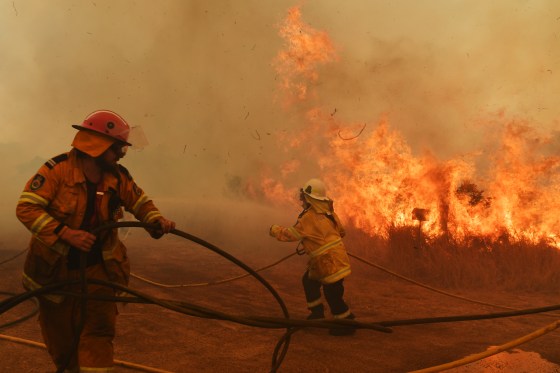
Bushfires Continue To Burn Across NSW As Catastrophic Fire Conditions Ease
Sam Mooy—Getty ImagesRFS Firefighters battle a spot fire on Nov. 13, 2019 in Hillville, Australia.

Morrison said the compensation was necessary so that the New South Wales fires commissioner is in a position to continue to call out the volunteer force.

The program is expected to cost AU$50 million ($34.9 million) but will be uncapped with the first AU$10 million ($6.9 million) being made available next month. Morrison said it would be offered to other states and territories requesting help.

Read more: Koalas Were Already on the Brink in Australia. Bushfires Have Killed 1,000 in 2 Months, Experts Say

Wildfires have also flared in Queensland, Victoria, Western Australia and South Australia.

New South Wales, the country’s most populous state, has received the brunt of the wildfire catastrophe, which has killed nine people nationwide and razed more than 1,000 homes in the past few months. High temperatures in the country’s east are expected until the new year. Sydney’s western suburbs were set to hit 41 degrees Celsius (106 Fahrenheit) Sunday before peaking at 44 C (111 F) on Tuesday.

Fire danger in Sydney and northern New South Wales is currently at very high.

New South Wales Rural Fire Services Commissioner Shane Fitzsimmons said 85 fires were still burning across the state with almost half of them not contained. “We’ve got some deteriorating weather conditions over the coming days, particularly Monday and worsening through to Tuesday,” he said.

An emergency warning was issued Sunday for Victoria’s east as conditions worsen. Melbourne, the state’s capital, was set to reach 43 C (109 F) on Monday.

Saturday, December 28, 2019

New world news from Time: 6 Rowers Become First to Cross Infamous Drake Passage Unassisted


(LOS ANGELES) — As freezing water thrashed their rowboat in some of the most treacherous waters in the world, six men fought for 13 days to make history, becoming the first people to traverse the infamous Drake Passage with nothing other than sheer manpower.

They dodged icebergs, held their breaths as giant whales breached near their small boat and rode building-sized waves while rowing 24 hours a day toward Antarctica.

The team of men from four countries finished crossing the Drake Passage on Wednesday in just under two weeks after pushing off from the southern tip of South America.

“This is a really big deal in Antarctic history to hear about this,” said Wayne Ranney, a Flagstaff, Arizona-based geologist who has led expeditions to Antarctica and crossed the Drake Passage in motorized vessels more than 50 times. “One hundred percent of their progress was done with those 12 arms for 600 (nautical) miles. That’s just phenomenal. I can’t even imagine.”

Besides the threat to their lives, the men labored under grueling conditions. Their 29-foot (9-meter) rowboat, named the Ohana, had to be in constant motion to avoid capsizing. That meant three men would row for 90 minutes while the other three rested, still cold and wet.

Drake Passage Record Row
Discovery/APThis image released by Discovery shows a scene from “The Impossible Row,” documenting endurance athlete Colin O’Brady and his crew’s crossing of the treacherous icy waters of The Drake Passage by row boat.

“You’re rowing inside an open hold, 40-foot sea waves are splashing in your face, near-freezing water is splashing over the bow,” said 34-year-old Colin O’Brady of Jackson Hole, Wyoming, one of the six men on the boat.

“It was quite harrowing,” O’Brady told The Associated Press on Thursday in his first interview after the journey. “By the end, we all lost a good amount of weight and were delirious from the sleep deprivation.”

The men had to use a bucket to go to the bathroom. To rest, two men needed to lie shoulder to shoulder in a tiny space while a third would lay in a fetal position in an even smaller area. “You’re curled up and jammed into a small space, trying to get a few winks of sleep before the alarm would go off and boom, you’re back at it again,” O’Brady said.

The toughest part for O’Brady’s fellow rower, Jamie Douglas-Hamilton of Edinburgh, Scotland, was the constant bombardment from the elements.

“We were hit by winds from every single direction … and the seas down here are very violent — it’s the roughest ocean in the world,” the 38-year-old said. “We almost capsized many times, and the problem with that is the water is so cold that if you go in, you’ve probably got two to five minutes.”

Physically, Douglas-Hamilton said he fought crippling seasickness and numb hands and feet. At one point, a strap he had to wear around his ankles while rowing wore through his boots and cut into his skin all the way to the bone.

“It was absolute agony,” Douglas-Hamilton said.

The other men on the expedition were: Fiann Paul of Reykjavik, Iceland; Cameron Bellamy of Cape Town, South Africa; Andrew Towne of Grand Forks, North Dakota; and John Petersen of Oakland, California.

Paul, Douglas-Hamilton and Bellamy are record-breaking ocean rowers, Towne is a championship rower and has climbed the tallest mountain on every continent, and Petersen was a championship college rower.

In addition to storms and waves, the men dodged icebergs and whales that could easily have destroyed their small vessel. And then there were the mental challenges, especially during the night shift.

“At night we can’t see the waves as they roll and crash into us and we can’t see the horizon so there is no sense of progress,” O’Brady wrote on Instagram as he documented the journey. “It feels like being inside of a washing machine, blindfolded where time is standing still.”


Discovery documented the journey while following the men in a larger, motorized boat. O’Brady’s wife, Jenna Besaw, was on the Discovery boat running logistics and watching her husband’s death-defying adventure.

“There have been some frightening, intense moments when our boat — a 120-foot-long boat — was lurching forward and up and over these massive waves, to see the rowboat hidden for minutes at a time was rather unnerving,” Besaw said.

The row across the Drake Passage is just the latest adventure for O’Brady, who became the first person to traverse Antarctica alone without help last year. A book about that journey is coming out on Jan. 14, 12 years to the day since O’Brady was severely burned in a fire in Thailand. After the fire, he said he was told he would never walk again. He said that prognosis has helped fuel each new adventure.

“I am dreaming of what’s next,” O’Brady said. “To be determined, but I don’t think my expedition life is over.”

For Douglas-Hamilton, the journey across the Drake Passage might be his last time setting a record, and he’s content with that.

“I would rank this as the toughest challenge any of us has ever done,” he said. “This was such a good one, I’d be happy leaving it at this. The memories from this one will last forever.”

New world news from Time: U.S. Contractor Killed, Military Personnel Injured in Rocket Attack on Iraqi Military Base


A rocket attack on an Iraqi military base killed an American contractor and wounded several U.S. and Iraqi military personnel, the Defense Department said.

Iraqi security forces were “leading the response and investigation” following the Friday night assault on the base in Kirkuk, where coalition forces are based, the Pentagon said in a statement. The names of the contractor and the wounded Americans were not immediately released, and the statement did not provide any further details.

Rocket assaults on or near Iraqi installations that host American troops and personnel have occurred since the fall, and Pentagon officials, including Defense Secretary Mark Esper, have expressed increasing concern about Iranian involvement.

Those attacks occurred as widespread anti-government protests intensified, eventually leading to the resignation of Prime Minister Adel Abdul-Mahdi.

Tensions have been rising across the region, with Iran violently putting down its own protests, and Turkey invading Kurdish territory in northern Syria after President Donald Trump announced a pullout of American forces there.

Early this month, rockets were fired at two Iraqi air bases where American forces are stationed. Seven rockets struck the perimeter of the Al Asad base, and five projectiles landed inside Balad. At Al Asad, the Iraqi army later found a truck rigged to fire rockets with seven empty tubes and eight unfired projectiles.

No one was hurt in those attacks, which were believed to be the work of militants with ties to Iran, according to a U.S. official.

On Thursday, Iraqi President Barham Saleh offered to resign as weeks of deadly protests showed no sign of easing. Mahdi remains in office until a successor is found. Protesters rejected one nominee, and Saleh rejected the candidacy of a second.

Some 500 people have died in clashes between security forces and protesters since Oct. 1, according to Iraq’s independent High Commission for Human Rights. Iraqis, mostly from the Shiite majority population, are protesting against corruption, poor services, and Iran’s sweeping influence in the country.

––With assistance from Khalid Al-Ansary and Tony Capaccio.

New world news from Time: Truck Bomb Explodes at Security Checkpoint in Somalia’s Capital, Killing 76


(MOGADISHU, Somalia) — A truck bomb exploded at a busy security checkpoint in Somalia’s capital Saturday morning, killing at least 76 people including many students, authorities said. It was one of the deadliest attacks in Mogadishu in recent memory, and witnesses said the force of the blast reminded them of the devastating 2017 bombing that killed hundreds.

The toll could rise as scores of people were rushed to hospitals, government spokesman Ismail Mukhtar told The Associated Press. Dr. Mohamed Yusuf, director of Madina hospital, said they had received 73 bodies. The Aamin Ambulance service reported at least 76 dead and more than 50 wounded.

Most of those killed were university and other students returning to class, Mayor Omar Mohamud Mohamed said at the scene. Two Turkish brothers were among the dead, Somalia’s foreign minister said.

Police Capt. Mohamed Hussein said the blast targeted a tax collection center during the morning rush hour as Somalia returned to work after its weekend. A large black plume of smoke rose above the capital.

Images showed the mangled frames of vehicles and bodies lying on the ground. At a hospital, families and friends picked through dozens of bodies. “I saw many dead bodies lying on the ground,” witness Mohamed Abdi Hakim said. “Some of those dead were police officers, but most of them were students.”

There was no immediate claim of responsibility. The al-Qaeda-linked al-Shabab often carries out such attacks. The extremist group was pushed out of Mogadishu several years ago but continues to target high-profile areas such as checkpoints and hotels in the seaside city.

The extremist group is now able to make its own explosives, its “weapon of choice,” United Nations experts monitoring sanctions on Somalia said earlier this year. The group had previously relied on military-grade explosives captured during assaults on African Union peacekeeping forces.

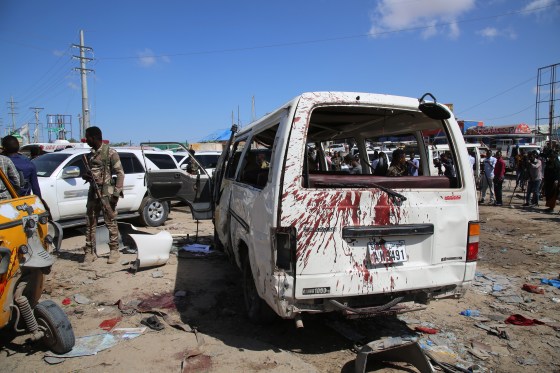
Truck bomb in Somali capital Mogadishu
Sadak Mohamed—Anadolu Agency/Getty ImagesWreckage in the aftermath of a truck bomb attack is seen in Mogadishu on Dec. 28, 2019.

Al-Shabab was blamed for the truck bombing in Mogadishu in October 2017 that killed more than 500 people. The group never claimed responsibility for the blast that led to widespread public outrage. Some analysts said al-Shabab didn’t dare claim credit as its strategy of trying to sway public opinion by exposing government weakness had badly backfired.

“This explosion is similar like the one … in 2017. This one occurred just a few steps away from where I am and it knocked me on the ground from its force. I have never seen such a explosion in my entire life,” said witness Abdurrahman Yusuf.

The latest attack again raises concern about the readiness of Somali forces to take over responsibility for the Horn of Africa country’s security in the coming months from the AU force.

Al-Shabab, the target of a growing number of U.S. airstrikes since President Donald Trump took office, controls parts of Somalia’s southern and central regions. It funds itself with a “taxation” system that experts describe as extortion of businesses and travelers that brings in millions of dollars a year.

___

Video journalist Mohamed Sheikh Nor in Mogadishu contributed.

New world news from Time: Russia Confirms It Will Appeal 4-Year Olympic Ban


(MOSCOW) — Russia confirmed Friday that it will appeal its four-year Olympic ban for manipulating doping data.

The Russian anti-doping agency, known as RUSADA, sent a formal letter disagreeing with the sanctions imposed earlier this month by the World Anti-Doping Agency. The case is now heading to the Court of Arbitration for Sport (CAS).

Next year’s Olympics in Tokyo will be the third consecutive edition of the games preceded by a legal battle over Russian doping issues.

RUSADA said it “disputes the (WADA) notice in its entirety,” including the evidence of tampering with the data archive. The data was handed over in January and was meant to clear up past cover-ups, but has led to more legal tussles.

RUSADA’s own CEO, Yuri Ganus, attached his own note of protest to Friday’s letter. Ganus is critical of Russian officials and had disagreed with the decision to appeal. He was overruled by his agency’s founders, which include some of Russia’s most influential sports leaders.

The WADA sanctions ban the use of the Russian team name, flag or anthem at a range of major sports competitions over the next four years, including next year’s Olympics and the 2022 soccer World Cup.

However, Russian athletes will be allowed to compete as neutrals if they pass a vetting process which examines their history of drug testing, and possible involvement in cover-ups at the lab.

That has prompted anger from some Western athletes and organizations like the United States Anti-Doping Agency, which wanted a blanket ban on Russian athletes.

The appeal was widely expected with Russian President Vladimir Putin having branded the ban “unfair.”

RUSADA’s supervisory board voted Dec. 19 to file an arbitration case with CAS in Switzerland after WADA ruled Russia had manipulated doping laboratory data to cover up past offenses. Putin has said it was not fair to threaten Russia with more doping-related punishment, and that any sanctions should be on an individual basis. “I think it is not just unfair but not corresponding to common sense and law,” Putin said.

After a panel of three CAS arbitrators is chosen, a verdict will be issued within three months.

Putin added that WADA’s recommended four-year ban on Russia hosting major sports competitions would have little effect, pointing to the 2022 men’s volleyball world championships as an event Russia intends to keep.

WADA demands events are moved unless it’s “legally or practically impossible” to do so, which could create a loophole for event organizers who don’t want to break financial commitments.

That ban already doesn’t apply to next year’s European Championship soccer games in St. Petersburg or the 2021 Champions League final, both of which are exempt because they’re continental, not world, championships.

Russia handed over the lab’s doping data archive in January in return for having earlier sanctions lifted in 2018. WADA investigators found evidence that Russia was intensively editing the data in the weeks before the handover to remove signs of failed drug tests.

WADA said it found fake messages spliced into chat logs in an apparent attempt to smear former lab director Grigory Rodchenkov, who’s become a key witness for WADA since leaving Russia.

New world news from Time: Afghanistan Faces a ‘Make-or-Break Moment,’ U.N. Chief Says

UNITED NATIONS — Warning that Afghanistan is facing “a make-or-break moment,” the United Nations chief on Monday urged the world t...