Eight people who were involved in the the torch relay for the Tokyo Olympics have tested positive for COVID-19—the latest sign of trouble for Japan as it both struggles with a spike in infections and prepares for the Games this summer.
More than 70% of people in Japan want the Olympics, which begin July 23, to be canceled or postponed, according to an April poll by Kyodo News. Runners of the relay, which began its journey to Tokyo on March 25 in Fukushima, have faced heckling and protests.
The Japanese government, however, insists that the Games will go ahead following their delay in 2020 due to the pandemic. COVID-19 protocols released last month rely on frequent testing and isolation bubbles for athletes and coaches, but not strict quarantines or vaccinations. Fans from abroad have been banned, and organizers are weighing whether to bar Japanese spectators, as well.
On Sunday, the country reported 5,900 new infections, and the number of COVID-19 patients with severe symptoms hit a record of 1,050 people. Japan last month declared a state of emergency for Tokyo, Osaka and other areas in an attempt to contain a fourth wave of coronavirus. Japan’s sluggish vaccination rate, one of the slowest among wealthy nations, isn’t helping. Less than 2% of the population has had at least one dose.
Kyodo News/AP ImagesOrganizing staff members of the Tokyo Olympic torch relay hold signs urging spectators to wear masks and maintain social distancing in the Oita Prefecture city of Beppu, southwestern Japan, on April 23, 2021, amid the coronavirus pandemic.
The country of 126 million people has recored more than 600,000 cases of the coronavirus, according to the Johns Hopkins University virus tracker. About 10,000 people have died. Despite the spike, infection rates remain far below those of the U.S. and Europe.
Those infected as part of the Olympic torch relay helped with traffic control and wore masks, according to local media. They had worked in the cities of Amami and Kirishima in Kagoshima prefecture, where the relay passed through on April 27. Two organizers who earlier helped with the relay on the island of Shikoku have also tested positive with the virus, including a police officer who helped direct traffic.
The torch relay has been scaled back in several locations as it winds its way across the country. Authorities in the western city of Osaka, a crowded metropolis, cancelled the public street route through the city and held it at a park without spectators.
Linq, which bills itself as an LGBTQ-friendly bar in Hong Kong’s Central district, roared back to life this weekend—more than 5 months closed due to COVID-19 restrictions. While revelers, some of them shirtless, danced to Dua Lupa inside on Friday night, bar staff outside struggled to make sure everyone was complying with the new government’s regulations that allowed Linq to open its doors.
Would-be patrons, hoping to get in, fumbled through technical difficulties as they downloaded the required government contact-tracing app to their phones and dug through their wallets to find proof that they’d been vaccinated. Others attempted to evade the checks. Some gave up and drank on the street outside, mingling with friends returning from the bar with handfuls of cocktails.
A.J. Verma, who is fully vaccinated, told TIME on Friday it felt a bit weird to be back in a bar while so much of the world still struggles with the COVID-19 pandemic. But, he couldn’t contain his excitement about Linq being opened again—he’d already been given a warning about hanging from a light fixture above the bar to dance. “We have to slowly get back to normal,” he says.
Bars and nightclubs across Hong Kong were allowed to resume business on April 29 as part of new rules that relaxed pandemic restrictions across the city. Among the regulations is a “vaccine bubble“—in which food and beverage establishments are allowed to host large groups and stay open until 2 a.m. for the first time in months, as long as all staff and customers can provide proof they have received at least one dose of a COVID-19 vaccine and use the government’s contact-tracing app.
Earlier in the week, the government also announced a quarantine-free “travel bubble” with Singapore—the first opportunity for most residents to leave the city and come back freely in more than a year—but only for those who have been fully vaccinated.
The moves are part of the semi-autonomous Chinese territory’s bid to boost sluggish vaccination rates—with is about 15% of the city’s 7.5 million residents receiving at least one dose two months into the vaccine drive. That figure is among the highest in Asia, but lackluster considering vaccination is free and open to all residents over age 16.
Experts say Hong Kong’s vaccine passport experiment could offer clues for other governments that are considering rolling out their own set of expanded privileges for people who have gotten COVID-19 shots.
Amy Gunia–TIMEPatrons crowd outside Linq Bar in Hong Kong’s Central district on April 30, 2021—after it re-opened following 5 months closed due to COVID-19 restrictions. Hong Kong’s new rules require bar visitors and staff to be vaccinated.
A complex set of rules
But, restaurant and bar owners say the new rules are frustratingly complex. Different sets of social distancing rules, labeled A through D, allow diners to sit in varying group sizes and stay until different times, depending on the vaccination status of the restaurant’s staff and guests, and whether the guests are using the city’s contact tracing app. They also allow for a raft of loopholes and work-arounds—including a combination of both vaccinated and unvaccinated patrons in some circumstances.
At The Old Man, an Ernest Hemingway-inspired cocktail bar, supervisor John Martin Aexel III says that he worries about alienating customers. “I’m not sure how we’re going to cope with it,” he says, over a Soldier’s Home #1925, a rum-based cocktail adorned with a mini alcohol-infused apple.
One provision of the rules requires anyone dining out after 10 p.m. to use the contact-tracing app—which has been met with privacy worries and skepticism by some Hong Kong residents.
“I’m gonna have to be put in a position where I’m gonna have to tell people to leave after 10 p.m. even though we don’t close until 12 a.m., because some people don’t want to use the [app],” Aexel says.
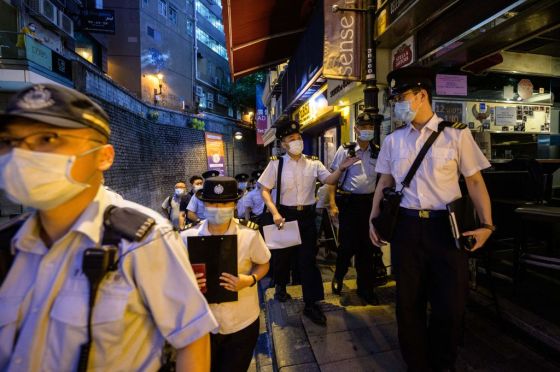
Anthony Wallace—AFP/Getty ImagesFood and Environmental Hygiene Department officers and police walk past restaurants and bars after they reopened, in Lan Kwai Fong, a popular drinking area in Hong Kong on April 29, 2021.
Many bars in the city had already outmaneuvered social distancing restrictions in a bid to survive. One gay bar, where on a normal night before the pandemic drag queens could be found lip-synching Ariana Grande medleys to a tightly-packed dance floor, reopened as a restaurant, serving food like nachos and mozzarella sticks. Others have operated illegally (one bar manager was jailed for allowing a 64-person birthday party). Another bar started serving takeout food and encouraging customers to drink on the street outside (consuming alcohol in public is legal in Hong Kong).
Health experts say these factors, combined with low trust in the Hong Kong government, could blunt the intended effects of convincing more people to get COVID-19 vaccines and allowing life to safely return to normal.
“It’s really, really complicated,” Zach Mazhar, who works at a bar and restaurant on a sticky street in the semi-notorious nightlife district Lan Kwai Fong, tells TIME over thumping music. “It’s going to be hard for us to manage.”
Why vaccine passports are controversial
Vaccine passports, regulations that require proof of COVID-19 immunization for some activities, have been controversial since they were first proposed as a way to safely kickstart economic activity.
Critics often cite privacy concerns and worries about government overreach. In the U.S., several states—including Arizona, Utah, Texas and Florida—have banned or restricted businesses and local governments from requiring people to disclose their vaccination status. “Vaccination is up to each individual, not the government,” Arizona Gov. Doug Ducey said in an April 19 press release. But New York rolled out a vaccine passport, becoming the first state to do so; its Excelsior Pass app can be used for access to places like Madison Square Garden.
Although a petition against the idea gathered more than 300,000 signatures, the U.K. has plans to test a COVID-19 passport program that would allow large crowds to return to theaters, nightclubs and stadiums—if people show proof of vaccination or of having recovered from COVID-19. Denmark and Israel have both rolled out similar programs.
The E.U. is expected to introduce its own vaccine passport program called a Digital Green Certificate, and South Korea announced it will exempt full-vaccinated people from the two-week mandatory quarantine for residents who return from overseas.
Ben Cowling, an infectious disease epidemiologist at the University of Hong Kong (HKU), says that, in general, vaccine passports aren’t desirable in the long-term, as they can drive inequity and discrimination for people who can’t recieve vaccines for medical reasons or might not otherwise have access to them. But in the short term, they might make sense in a place like Hong Kong where shots are currently widely available.
As countries around the world rush to vaccinate their citizens, the financial hub Hong Kong is facing a problem few places have: a large supply of vaccines, and an ambivalent population.
Hong Kong residents can choose to receive the BioNTech vaccine or China’s Sinovac. But only about 15,000-20,000 people a day are showing up to get their first dose. The government’s vaccine booking website shows many available appointments in the coming days. Local media reported in early April that health experts warned that it might take more than a year to reach herd immunity. But that might not be possible on any timeline; in a YouGov poll of Hongkongers last summer, only about 40% said that they will take a COVID-19 vaccine.
The reasons for this are complex. Many feel don’t feel that they need a vaccine to protect them from the virus. Hong Kong has kept the pandemic in check with a combination of strict border controls, social distancing measures, contact tracing and widespread testing. Mask-wearing is ubiquitous. Since the pandemic began, around 12,000 cases have been recorded in the former British colony, but only about 200 people have died—rates that are a small fraction of those in the U.S. or Europe.
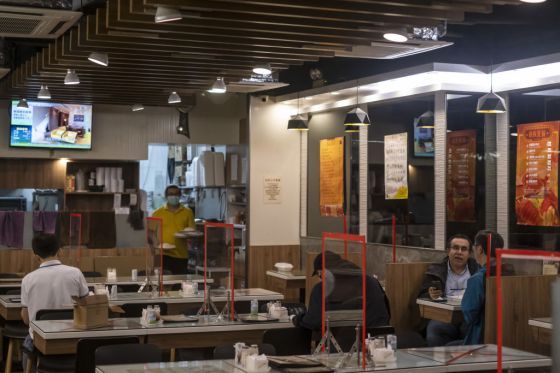
Justin Chin—Bloomberg/Getty ImagesPlastic barriers stand on tables to enforce social distancing measures due to the coronavirus at a restaurant in Hong Kong on March 28, 2020.
In addition to launching a vaccine passport, the Hong Kong government is taking more coercive actions to boost vaccination rates. Officials announced that the city’s 370,000 foreign domestic workers—who are mostly from the Philippines and Indonesia—would be required to be tested regularly for COVID-19 unless they were vaccinated. Vaccination would also be required for visa renewal. The news sparked criticism, including from Philippines’ foreign affairs secretary Teodoro Locsin Jr., who said on Twitter that the plan, “smacks of discrimination.”
For many, the new regulations won’t profoundly change the way they’re living. Gyms have already reopened and the size of gatherings in private spaces hasn’t been restricted since the pandemic began. Despite group size limits at restaurants, larger groups are often seated together with sheets of plexiglass between them—which are, in theory, meant to block contact and reduce disease transmission, but in practice are small enough that people are able to talk around them.
Hongkongers interviewed by TIME at a vaccination center were either not aware of the new incentives, or said they were not the reason they had gotten vaccinated.
But the new rules have prompted at least some people to get a jab. Ming, a 23-year-old Hongkonger, tells TIME he was on the fence about getting the vaccine. “My family was telling me your face can’t even move after the vaccine,” he says, referring to a rare and temporary side-effect of the BioNTech jab. But knowing that his vaccinated friends would be able to go to bars this weekend convinced him to book his first dose for Friday. “I don’t want to party at 7-Eleven when all my friends can party at the bars,” he says, referring to the practice of buying beer from a convenience store and drinking on the street.
Some say that no incentives will convince them to get a jab. Ron Poon, 29, tells TIME that he has safety concerns over the vaccines, and he wants the government to provide more data about their long-term effects. “I haven’t travelled in two years, it’s become a habit,” he says. “I won’t put my health at risk.”
But others are happy to be returning to some of their pre-pandemic activities. “I’m happy and comfortable to go out and be in a space that has other vaccinated people,” says Verma, who attended Linq’s “Cherry Pop” pop music night on Friday. “This place is my church.”
NEW DELHI — India’s Prime Minister Narendra Modi suffered a resounding defeat in a key state election on Sunday, indicating his Hindu nationalist party’s political strength may be slipping as the country struggles to contain an unprecedented surge in coronavirus cases.
Modi’s Bharatiya Janata Party (BJP) was unable to dislodge West Bengal state’s firebrand chief minister, Mamata Banerjee, after a hard-fought campaign.
On Sunday night, Modi took to Twitter to congratulate rival Banerjee’s win. “The Centre will continue to extend all possible support to the West Bengal Government to fulfill people’s aspirations and also to overcome the COVID-19 pandemic,” he wrote.
His party also failed to win in two southern states, Tamil Nadu and Kerala. But the BJP secured a second term in the northeastern state of Assam and an alliance with regional parties led it to victory in the union territory of Puducherry.
Even before the current virus surge, Modi’s party faced stiff challenges in these local legislative elections. Following the disappointing results, Modi stands weakened but faces no threats to staying on as prime minister until his term ends in 2024.
“The BJP started running out of steam as the pandemic spread,” political analyst Nilanjan Mukhopadhyay said.
“The verdict in West Bengal state will definitely weaken Modi’s position,” he added, but cautioned that the results needed to be studied further to determine how much they were a referendum on the BJP’s handling of COVID-19.
In West Bengal, Banerjee’s All India Trinamool Congress picked up 213 seats out of 292, while the BJP secured 77, according to the Election Commission of India. Two went to other parties.
Supporters of the All India Trinamool Congress party — many without masks and ignoring social distancing guidelines — held victory celebrations and set off firecrackers in West Bengal after initial results were released.
Health experts say the massive electoral rallies and marches held as voters cast their ballots in March and April are partly to blame for the subsequent spike in COVID-19 infections. Public anger for allowing the elections to go forward despite the risk has been directed at both Modi’s government and the Election Commission.
Last week, the High Court in Tamil Nadu state slammed the Election Commission for allowing crowded campaigns in the middle of the pandemic. India’s daily new virus cases began rising past 100,000 in late March, and above 300,000 daily new cases on April 21, collapsing India’s tattered health care system.
“Your institution is singularly responsible for the second wave of COVID-19. Your officers should be booked on murder charges probably,” the court said.
Polly Roy, a professor of virology at the London School of Hygiene and Tropical Medicine, said last week that India’s extremely dense population and the government’s lax rules about election rallies and religious gatherings fueled the outbreak. Experts have also blamed new, more contagious virus variants.
Nationwide, death is so omnipresent that burial grounds are running out of space in many cities, and glowing funeral pyres blaze through the night. With the government unable to maintain a steady supply of oxygen to overwhelmed hospitals, desperate relatives plead for oxygen outside or weep in the street for loved ones who died waiting for treatment.
On Sunday, India recorded a slight drop in new infections with 392,488, down from a high of 401,993 in the previous 24 hours. It also reported 3,689 additional deaths, bringing the total number of fatalities to 215,542. Experts believe both figures are an undercount.
Modi’s party soared in Hindu-dominated regions in central and northern India since he was elected in 2014. The recent local elections were seen as crucial for the party to gain a foothold in three states that have sizeable minority Muslim populations. The Hindu nationalist BJP has for years been accused of stoking religious polarization and discriminating against minorities.
The prime minister also wants to project the BJP as a national party, replacing a dynastic Congress party that governed India for more than six decades after independence from British rule in 1947. The Congress party, led by Sonia Gandhi, did poorly in the recent elections, failing to capture power from the BJP in Assam or from Communist parties in Kerala.
As India’s COVID-19 second wave began to surge last month, the country’s largest-selling newspaper, the Hindi-language Dainik Bhaskar, splashed its Apr. 15 front page with a night-time shot of a crematorium in the city of Bhopal, dotted with the ghoulish orange glow of pyres. The banner headline declared, “The government’s data are fake, the pyres tell the truth.”
That day, Bhopal officially reported four COVID-19 deaths. But the paper found that the three crematoriums in the city had conducted the funerals of 112 COVID-19 victims. Similar under-reporting in other parts of the country was called out by newspapers, television channels and online media. In Gujarat, the home state of Prime Minister Narendra Modi, the city of Ahmedabad declared 20 COVID-19 deaths on Apr. 12. Local paper Sandesh reported that at just one city hospital, 63 people died of the virus that day.
The COVID-19 catastrophe unfolding in India is being painstakingly chronicled by Indian journalists, who are holding the government to account for it. For India’s mostly servile media, this is a striking break from the usual after seven years of Modi. It’s also a little late.
Many Hindi- and English-language news channels, as well as regional news outlets, are unabashedly pro-Modi. They have routinely exaggerated the government’s successes and either glossed over its failures or spun ways to pin them on Modi’s discontents: the opposition, liberals, Muslims, activists, leftists, protesters, NGOs, and other assorted “anti-nationals.”
The government’s handling of the pandemic has now made the scale of COVID-19 damage difficult to hide for even the staunchest of its media friends. But it is that media’s Pavlovian obeisance to power that helped the build-up of this epic tragedy. A media trained to amplify the ruling party uncritically failed to hold it to account when there was time, and force real action. All that has happened—the collapsing healthcare system, the mountains of corpses, the nationwide hunt for oxygen and the scramble for a piece of earth to give the dead the dignity denied to them in life—is as much on the media as it is on the government.
Raj K Raj/Hindustan Times via Getty ImagesA view inside the Covid-19 care center at the Commonwealth Games Village, on May 2, 2021 in New Delhi, India.
How watchdogs became poodles
The taming of India’s media began with Modi’s rise to national power in 2014. His ascent was accompanied by a remaking of the editorial leadership of some of India’s major news organizations, in particular national-level television networks. The previous crop of senior editors, seen to be more loyal to the liberal vision of India rather than his Bharatiya Janata Party’s (BJP) Hindu nationalist worldview, were eased out and new channels and news leaders, with fealty to the party and Modi, were established.
Democratic governments elsewhere seek validation from the media, and their spin doctors toil for favorable headlines. In India, Modi has ensured it is the media outlets—with a few honorable exceptions—that seek the government’s approval. For a dominant section of the media, derisively called “godi media” (Hindi for “lapdog media”), every news show is as much a competition for ratings as it is for gaining the master’s affections.
India’s federal and provincial governments wield enormous power over media corporations because of their hefty state and party advertising budgets. The federal government alone spent about $270,000 on advertisements every day in the 2019 to 2020 financial year. Access to power and business favors add to the inducements to stay on message. Modi has used these levers to turn some of the biggest names in India’s news industry from barking watchdogs into obliging poodles. Today India ranks 142nd out of 180 territories in the World Press Freedom Index, below the military-ruled states of Myanmar (140) and Thailand (137).
This lowly status is most acutely felt in the poor quality of public information. The media echo chamber ensures that bad news never sticks to the government. Or better still, never gets out. The diversions are blatant and often laughable. When Modi suddenly pulled high-value banknotes from circulation in a supposed war on dark money in 2016—a crippling shock from which the economy never recovered—some news presenters gushed that the replacement notes would come embedded with “nano GPS chips,” making them impossible to hide.
Sanjeev Verma/Hindustan Times via Getty ImagesA Covid-19 patient receiving oxygen support in a car at an “Oxygen langar” by Gurdwara Damdama Sahib, on May 2, 2021 in New Delhi, India.
Amplifying Modi’s narrative on the pandemic
Just as common as misinformation is the cheerleading for Modi’s every move. Whatever the prime minister does is a “masterstroke.” And so it has been with the handling of the pandemic. India’s first COVID-19 case was confirmed in January last year, but his government dismissed the opposition’s warnings about the coming disaster well into March. “There’s no need to panic,” the country’s health minister tweeted on Mar. 5, 2020. “India DOES have a robust healthcare system which is being appreciated globally.”
But just a couple of weeks later, Modi declared one of the world’s most severe lockdowns with a mere four hours’ notice. The incomes of millions living in precarity vanished in an instant, triggering an unprecedented mass migration of daily wage earners from the cities back to their villages. Hundreds died trying to get home amid the lockdown. The economy crashed 24%. The number of poor people increased by 75 million, accounting for 60% of the global increase in poverty that year.
The media protected Modi from any proper public scrutiny of his initial handling of the pandemic. He made repeated television appearances in which he said little of substance and offered no concrete plans to tackle the crisis. Instead, he called for festivals of sound and light, and ordered the armed forces to shower flowers on hospitals—all of it hyped up by doting anchors as proof of Modi’s strong leadership.
The series of spectacles helped keep the attention away from the crisis affecting migrant laborers and a meltdown of the healthcare system and the economy during the first wave. “Godi media” also chipped in with reports blaming Muslims for spreading COVID-19, following the Delhi gathering of an apolitical Islamic organization called Tablighi Jamaat. The media happily disseminated the idea that this was a deliberate superspreader event, with daily reportage suggesting a wider “corona jihad” by Muslims.
As the virus waned after the first surge, Modi set the media narrative that it was his “decisive” lockdown that had saved the country, and prematurely declared victory against the disease. Then, even as scientists warned another wave was imminent, Modi led state after state into elections, with every election rally a chance for unmasked crowds to gather while the media whipped up campaign fever with wall-to-wall coverage. While his government stopped preparing for a second wave, television channels gave it prime time slots for the promotion of snake-oil cures for COVID-19 rather than tracking the progress in building up oxygen and hospital capacity.
The media also amplified Modi’s propaganda touting Indian vaccine leadership. One of the two “Indian” vaccines is homegrown but the major one, the Oxford-AstraZeneca one, is as Indian as Mercedes-Benz is Chinese—simply made in India under an outsourcing contract. Modi wasn’t “giving away” vaccines to the world, as the headlines suggested. Except for a tiny amount of Indian handouts, vaccines manufactured by two Indian companies were sent abroad either as part of an agreed global program of equitable vaccine distribution, or as commercial exports. And there was a lot to export, because Modi wasn’t buying much for his own people.
Neither did Modi help the two Indian companies scale up production to meet India’s needs, nor did he allow in foreign vaccines, as that would jar with his India vaccine story. Now vaccines are in short supply and the vaccination rate is abysmally low. If the media had demanded to know what exactly he was doing to vaccinate his people, apart from talking about it, India might have tackled the second surge better.
At every step of the COVID-19 saga over the past year, major sections of the Indian media have abdicated their oversight responsibility. They refused to question Modi, and allowed him to use a national disaster to bolster his image, consolidate power, stifle dissent and masquerade grandstanding as governance. Like Modi, they failed India when India needed them most. Indians and the world now blame Modi’s government for dropping the ball in the fight against COVID-19. Media houses who rolled over for India’s rulers are equally culpable.
SEOUL, South Korea — North Korea on Sunday warned the United States will face “a very grave situation” because President Joe Biden “made a big blunder” in his recent speech by calling the North a security threat and revealing his intent to maintain a hostile policy against it.
Last week, Biden, in his first address to Congress, called North Korea and Iran’s nuclear programs “serious threats” to American and world security and said he’ll work with allies to address those problems through diplomacy and stern deterrence.
“His statement clearly reflects his intent to keep enforcing the hostile policy toward the DPRK as it had been done by the U.S. for over half a century,” Kwon Jong Gun, a senior North Korean Foreign Ministry official, said in a statement. DPRK stands for the Democratic People’s Republic of Korea, the North’s official name.
“It is certain that the U.S. chief executive made a big blunder in the light of the present-day viewpoint,” Kwon said. “Now that the keynote of the U.S. new DPRK policy has become clear, we will be compelled to press for corresponding measures, and with time the U.S. will find itself in a very grave situation.”
Kwon still didn’t specify what steps North Korea would take, and his statement could be seen as an effort to apply pressure on the Biden administration as it’s shaping up its North Korea policy.
The White House said Friday administration officials had completed a review of U.S. policy toward North Korea, saying Biden plans to veer from the approaches of his two most recent predecessors as he tries to stop North Korea’s nuclear program. Press secretary Jen Psaki did not detail findings of the review, but suggested the administration would seek a middle ground between Donald Trump’s “grand bargain” and Barack Obama’s “strategic patience” approaches.
Kwon’s statement didn’t mention Psaki’s comments.
After a series of high-profile nuclear and missile tests in 2016-17, North Korean leader Kim Jong Un launched summit diplomacy with Trump on the future of his growing nuclear arsenal. But that diplomacy remains stalled for about two years over differences in how much sanctions relief North Korea could win in return for limited denuclearization steps.
In January, Kim threatened to enlarge his nuclear arsenal and build more high-tech weapons targeting the U.S. mainland, saying the fate of bilateral ties would depend on whether it abandons its hostile policy. In March, he conducted short-range ballistic missile tests for the first time in a year, though he still maintains a moratorium on bigger weapons launches.
“If Pyongyang agrees to working-level talks, the starting point of negotiations would be a freeze of North Korean testing and development of nuclear capabilities and delivery systems,” Leif-Eric Easley, a professor at Ewha University in Seoul, said. “If, on the other hand, Kim shuns diplomacy and opts for provocative tests, Washington will likely expand sanctions enforcement and military exercises with allies.”
Also Sunday, an unidentified North Korean Foreign Ministry spokesman vowed a strong, separate response to a recent State Department statement that it would push to promote “accountability for the Kim regime” over its “egregious human rights situation.” He called the statement a preparation for “all-out showdown with us.”
Kim’s powerful sister, Kim Yo Jong, also slammed South Korea over anti-Pyongyang leaflets floated across the border by a group of North Korean defectors in the South. The group’s leader, Park Sang-hak, said Friday he sent 500,000 leaflets by balloon last week, in a defiance of a new, contentious South Korean law that criminalizes such action.
“We regard the maneuvers committed by the human waste in the South as a serious provocation against our state and will look into corresponding action,” Kim Yo Jong said in a statement.
She accused the South Korean government of “winking at” the leaflets. Seoul’s Unification Ministry responded later Sunday saying it opposes any act that creates tensions on the Korean Peninsula and it will strive to achieve better ties with North Korea.
Easley said the North Korean statements by Kwon and Kim Yo Jong show that “Pyongyang is trying to drive a wedge between South Korea and the United States” ahead of the May 21 summit between Biden and South Korean President Moon Jae-in.
BERLIN — At least 93 police officers were injured and 354 protesters were detained after traditional May Day rallies in Berlin turned violent, the city’s top security official said Sunday.
More than 20 different rallies took place in the German capital on Saturday and the vast majority of them were peaceful. However, a leftist march of 8,000 people through the city’s Neukoelln and Kreuzberg neighborhood, which has seen clashes in past decades, turned violent. Protesters threw bottles and rocks at officers, and burned garbage cans and wooden pallets in the streets.
“Violence against police officers and a blind, destructive rage has nothing to do with political protest,” Berlin state interior minister Andreas Geisel said.
Geisel condemned the throwing of bottles and rocks, the burning barricades on the streets and especially the violence toward police.
“The high number of injured officer leaves me stunned. I wish all of those who were injured in the line of duty a quick recovery,” he said.
There’s a nightly curfew in most parts of Germany because of the high number of coronavirus infections, but political protests and religious gatherings are exempt from the curfew.
In France, May Day marches in Paris and the southern city of Lyon were also marred by scattered violence, with riot officers targeted by small groups of violent demonstrators who tossed projectiles and trash bins. Police made 56 arrests — 46 of them in Paris, the Interior Ministry said Sunday. It said six officers suffered injuries, three of them in Paris.
The CGT labor union that organized the main Paris march said violent demonstrators also targeted its marchers at the end of the rally, showering them with projectiles, blows and homophobic, sexist and racist insults. The union said 21 of its participants were injured, four seriously.
Joe Biden has been president of the United States for 100 days—here’s what Biden’s first 100 days tell us about the next 100 and beyond.
There is no reset with China coming. To China’s dismay, Biden’s arrival didn’t change the trajectory of U.S.-China relations in any meaningful way. Nor will it—there is zero popularity for Biden to win domestically by taking a more conciliatory approach to Beijing. But it’s not just U.S. politics that is preventing a reset with China; Biden has deep-seated ideological issues when it comes to dealings with China. Biden and key members of his team (like Secretary of State Tony Blinken) believe in a rules-based world order, one built atop respect for multilateralism, democracy, and human rights. A practical and consensus-driven Biden may have been willing to give more leadership space to the Chinese if they were willing to play by the same rules… but they aren’t (see: WHO, Hong Kong, Xinjiang). That means more competition with Beijing, and on multiple fronts: tech, trade, and vaccine diplomacy chief among them. Even the one area that should foster cooperation—climate change—is becoming increasingly competitive. While the Biden administration is still working on its comprehensive review of China policy, we’ve seen enough over the first 100 days to know rockier times lie ahead.
There’s less reset with the rest of the world than you might expect. In his first 100 days, Biden has reentered the Paris Climate Agreement and revived nuclear talks with the Iranians; he’s also talked tough and taken punitive measures against Russia and Saudi Arabia for actions the previous U.S. administration let slide. But despite these moves, the world has not suddenly rushed back into America’s embrace. Some of that has to do with the last four years and the realization that U.S. commitment to allies cannot be counted on beyond the next presidential election; but much more has to do with shifting geopolitical priorities in Washington and elsewhere. The first 100 days of the Biden administration have already shown that the U.S. is keen to move away from the Middle East—as seen with the Armenian genocide recognition (distancing it further from Turkey), frostier relations with Saudi Arabia, and the announced drawdown of U.S. troops in Afghanistan—so that it can shift its attention to Asia. Meanwhile, the U.S. and Europe are still very divided, both because of disagreements over values (like data privacy, for example) as well as over foreign policy (the U.S. withdrawal from Afghanistan being the latest; more fundamental disagreements center on how combative an approach to take towards China/Russia). The last four years have forced capitals to look out for themselves and pursue their own geopolitical objectives; 100 days of a Biden administration hasn’t suddenly ended that.
Good timing + competence = Covid success. Biden inherited Operation Warp Speed and the contracts that put the U.S. in vaccine pole position, but he and his team have also helped bring both stability and predictability to the domestic response, rocketing past its promise to deliver 100 million jabs in its first 100 days. The U.S. has done such a good job with its vaccination drive that it is now in position to start exporting millions of vaccine doses around the world to countries in desperate need of them, a much-needed booster shot to U.S. soft power after recent years. Of course, as the current situation in India has demonstrated, the world is hardly through the pandemic, and the prospect of more variants cropping up are serious cause for concern. Still, we’re the closest to normal we’ve been since the first quarter of 2020, and that was nowhere near guaranteed when Biden assumed office on January 20th.
Biden is serious about being a transformational president. We’ve seen Biden’s ambition when it comes to climate change, to an international tax plan and to reviving the U.S. economy. The latter stands out in particular as the Biden team looks ready to pump trillions into infrastructure (very broadly defined) in an attempt to modernize the outdated social contract of the 20th century for the realities of the current one. It remains to be seen how successful he will ultimately be—polarization in Washington remains as powerful a force as ever—but the fact that a large-scale attempt is being made is real progress. Beyond that, while Biden uses the rhetoric of American exceptionalism, in practice he understands more than many U.S. politicians that many of the structural problems facing the U.S. in 2021 require global buy-in and international cooperation, and that the ability of the U.S. to bully others into falling in line is limited. Under Biden, we’re beginning to see acceptance in Washington that the U.S. may no longer lead the world the way it once did, but it still remains its most significant player—that’s a type of power the Biden team is willing to lean its shoulder into, and signifies a transformation of its own kind as well.
*
One final observation to make 100 days into the Biden presidency. So far, Biden has been much more successful tackling domestic problems than international ones… and that’s directly the result of Donald Trump. If Trump didn’t initiate Operation Warp Speed, the vaccine rollout in the U.S. would be much more similar to the European Union at the moment; and if Trump didn’t push a stolen election narrative that kept GOP voters in Georgia from the polls and handed the Senate over to Democrats, Biden wouldn’t have the legislators he needs to push through such massive stimulus programs. Presidents must play the hands they were dealt; so far, Biden has played his cards as well as one could hope. But with just 100 days under his belt, there are plenty more rounds left to go.