Captain Tom Moore, the British war veteran who raised millions for charities supporting the country’s health service during the early days of the COVID-19 pandemic, has died with the virus aged 100.
In April 2020, Moore committed to walking 100 laps of his garden before his 100th birthday to raise money for charities supporting the National Health Service (NHS). His endeavor quickly made him a national sensation, and raised a total of £32.9 million ($45 million).
Moore was embraced by the U.K. government as a national hero for his fundraising efforts, and received a knighthood from Queen Elizabeth II, at a time when the government was facing strong criticism over its mismanagement of the COVID-19 pandemic. The U.K. is the fifth-worst hit country in the world in terms of total deaths with the virus, with more than 108,000 as of Tuesday. It has a higher death rate per capita than any of the countries with more deaths.
Moore’s family confirmed his death in a statement. “It is with great sadness that we announce the death of our dear father, Captain Sir Tom Moore. We are so grateful that we were with him during the last hours of his life.”
“The last year of our father’s life was nothing short of remarkable,” they said. “He was rejuvenated and experienced things he’d only ever dreamed of. Whilst he’d been in so many hearts for just a short time, he was an incredible father and grandfather, and he will stay alive in our hearts forever.”
Prime Minister Boris Johnson said in a statement: “Captain Sir Tom Moore was a hero in the truest sense of the word. It is quite astonishing that at the age of 100 he raised more than £32 million for the NHS, and so gave countless others their own chance to thank the extraordinary men and women who have protected us through this pandemic. He became not just a national inspiration but a beacon of hope for the world.”
Moore had been admitted to hospital on Monday with COVID-19. Although the U.K. has been vaccinating people in his age group for several weeks, he reportedly had not received one because he had been suffering from pneumonia.
On February 1, Myanmar’s military arrested leaders of the country’s civilian-led government and declared a one-year state of emergency. After a decade-long experiment with limited direct democracy, the junta is firmly in charge, and a small nation that once seemed to offer a roadmap for transition out of armed dictatorship is now once again under lockdown.
For nearly half a century, the army ruled this southeast Asian country. Then, in 2011, desperate to draw more investment into the country (and their own pockets) without becoming dangerously dependent on China, the generals cut a power-sharing deal with opposition leader Daw Aung San Suu Kyi and her National League for Democracy (NLD).
Though forbidden to hold office herself, Aung San Suu Kyi led her party to a landslide win in 2015 election and an even bigger victory over an army-backed opposition party on November 8. (Turnout was 70%, despite the pandemic, and the NLD won 83% of parliamentary seats.) The military, embarrassed by the scale of the NLD’s victory, claimed the election was rigged and demanded a recount. Talks with the NLD went nowhere, and tanks and troops then hit the streets before a new session of parliament could ratify the results. The coup is now accomplished.
This is an ugly story of fragile democracy and brute force, but it is not a simple morality play. Aung San Suu Kyi is a complicated figure. The sacrifice of her freedom—she spent 15 years under house arrest between 1989 and 2010—and the force of her personality made the 2011 power-sharing deal possible. But when the army murdered members of the mostly Muslim Rohingya minority in 2017 and drove 750,000 more from the country, Aung San Suu Kyi publicly defended her country. And the November election was hardly free and fair—though not for the reasons the military claims. Rohingya and other ethnic and religious minorities were largely blocked from voting.
Will international pressure reverse this coup? No. The Biden administration, facing its first spontaneous foreign-policy test, will surely threaten, and then impose, further sanctions. The Obama administration worked hard to encourage Myanmar’s tentative steps toward democracy. The U.S. eased previous sanctions designed to bolster Aung San Suu Kyi at the military’s expense, and Obama visited Myanmar in 2012. But the administration ignored warnings from rights groups that a full lifting of sanctions should wait for better treatment of the Rohingya and other ethnic and religious minorities.
U.S. and European financial penalties and restrictions on exports of military equipment to Myanmar in response to the ethnic cleansing of the Rohingya have accomplished little. Stricter measures are unlikely to impress army chief Min Aung Hlaing, who has far more to fear from democratization in Myanmar than from threats by Western officials. Continued military control of lucrative state properties ensures the generals will prosper even as their country buckles.
Nor will it be lost on anyone in the Biden administration that this is an especially awkward moment for the U.S. to defend democracy from attempts to seize power by those who claim election fraud. (Biden also knows that, unlike the situation in Washington, where the American military offered no support for those who would overturn the November election, the power-grab in Myanmar is an actual coup backed by overwhelming force.) Myanmar’s neighbors will do nothing to further isolate the country. Japan and the Southeast Asian democracies will mind their own business. Thailand, where the military remains in power after a successful coup in 2014, will be only too happy to continue trade with Myanmar.
The winner is China, which will now become an ever-more important source of financial help as Western sanctions take a toll. As part of its Belt and Road infrastructure investment project, the two countries have already signed deals for construction of a China-Myanmar Economic Corridor, a project that will boost commerce for Myanmar while giving China land access via highway and rail to a strategically valuable deep-water Indian Ocean port on Myanmar’s west coast.
When Myanmar’s generals made their democracy deal a decade ago, they hoped to open the country to both Western and Chinese investment. Now that they’ve clawed back full power, they’ll depend almost exclusively on China. Beijing is happy to do business with anyone in power in Myanmar, but the Western retreat will be welcome news.
There is a Chinese saying, “misfortune is a blessing in disguises.” Being the first country to be hit by the COVID-19 outbreak, China is also among the first economies that are recovering rapidly from the outbreak. Beating pessimistic forecast, Beijing expanded its economy by 2.3 percent in 2020, making it the only major economy registering positive growth last year.
What is also rebounding is its air pollution level. According to Finland-based Centre for Research on Energy and Clean Air (CREA), by early May levels of concentration of air pollutants – PM2.5, NO2, SO2 and ozone – all returned to or exceeding the monthly levels recorded the previous year. In October, PM2.5 concentrations in the Beijing-Tianjin-Hebei region, the China-equivalent to Germany’s densely packed Ruhr region, saw an increase of 15.6 percent over the same month last year, raising concerns that the region risks falling short of its winter pollution control targets.
To the extent that the coronavirus lockdown reduced traffic and economic activities, it is no surprise that China saw the rebound of emissions from power plants, industry and transport as the lockdown was lifted and economic activity and industrial production resumed. But the return to air pollution in China threatens to reverse past gains of pollution control in the world’s largest emitter. Prior to the outbreak, the improvement in air quality achieved by sweeping air quality control measures was already being offset by the rapid increase in the production and consumption of steel and coal since 2017. According to an analysis of PM2.5 data in 15 major Chinese cities, conducted by an Asia-based social enterprise Smart Air, PM2.5 concentration level increased in more than half of the cities in 2019.
Herein lies the quandary for Chinese leaders: despite party leaders’ proclaimed strong commitment to pollution control, they cannot resist the urge to pursue robust economic growth in order to ensure employment and maintain sociopolitical stability. Yet under China’s existing industrial structure, which relies on energy-driven heavy industry to generate growth, this effort is bound to undermine pollution control efforts. In 2019, more than 66 percent of the electricity in China was generated using coal power, which is a leading contributor to air pollution in China. Convinced that high economic growth ultimately leads to environmental improvements, some Chinese elites insist that economic development is a sine qua non for solving the country’s environmental problems. Justin Yifu Lin, a renowned government economist in China, even argued that economic growth was not the primary factor behind China’s smog problem, and that China should speed up growth to fundamentally solve its environmental crisis. In September 2019, Premier Li Keqiang reaffirmed that economic development be taken as the central goal.
The post-COVID-19 economic recovery in China has only exacerbated the dilemma between environmental protection and economic growth. In order to get China’s economy back on track, Premier Li called for revitalizing “stall economy,” i.e., encouraging people to set up curbside stalls as full-time jobs. Yet these open-air street shops are also considered a “stumbling block” to China’s efforts to “win the blue sky war.” The debate placed Premier Li at odds with President Xi Jinping, who over the past years has led a clean air campaign against street vendors.
Unfortunately, the archaic governance structure in China does not help resolve this dilemma. When top leaders themselves disagree with each other on policy priorities, subordinates gain more leeway to exercise strategic disobedience or “buck-passing” – shirking their responsibilities in pollution control. A provincial leader recently asked local industries to “go all out to make up for the loss” incurred by the outbreak. A city party secretary of the eastern Jiangsu province urged local cadres to “accelerate economic growth with passion.” As GDP growth becomes a top priority, pollution control is on a back burner. The coal-fired capacity under construction and in planning in June 2020 saw a 21 percent increase over the end of 2019. The party boss of the Ministry of Ecology and Environment admitted that while the situation of environmental degradation remains grim in China, the urge to stimulate local economic growth only make it more difficult to sustain environmental protection efforts.
Inability to rein in pollution threatened to wear away the existing public health gains of pollution control. Air pollution alone caused more than 49,000 deaths in Beijing and Shanghai in the first half of the year, a figure that is ten time more than the official national coronavirus death toll (4,634). Since a primary cause of air pollution is the burning of fossil fuels, also considered a major contributor to climate change, massive stimulus measures from the government also cast doubts on China’s ability to achieve carbon neutrality by 2060.
Dirty economic recovery has profound implications for China’s future economic health as well. According to a report released by Greenpeace and CREA, in 2018, dirty air cost 6.6 percent of China’s GDP, compared to 5.4 percent for India and 3 percent for the United States. Pollution also reduces grain yield by severely impeding photosynthesis. A Chinese agriculture expert suggested that if smog persists at high levels, China’s agriculture sector would suffer conditions “somewhat similar to a nuclear winter.” As food security concerns mount in the country, China faces growing pressure to import more grain from world market. Pollution is also threatening China’s political stability. According to a Harvard survey conducted in 2016, one-third of respondents in China said they would petition or protest against air pollution had it negatively affected their own health or the health of their family members.
But the impact of air pollution is not going to be confined within China’s borders. Research suggested that air pollution from China contributes to up to 65 percent of the ozone increase in the Western United States. A Pew survey in March 2020 reveals that China’s impact on the global environment tops Americans’ list of concerns toward China. China’s failure to tackle such internal challenges may also prompt the state to act more aggressively on the foreign policy front to deflect domestic criticism in an attempt to shore up its political legitimacy. The end result could be a faltering China that is perhaps more dangerous than a rising one.
Just before 5 a.m. Monday, three officers from Myanmar’s national police force showed up at Po Po’s home in Yangon. The officers, two of whom carried rifles, asked for her husband Min Thway Thit, a former leader of a prominent dissident student union. “They said they wanted to ask some questions,” says Po Po. “I asked whether they had a search warrant to enter his room, and they told me it wasn’t necessary.”
Myanmar’s military, known as the Tatmadaw, staged a coup against the democratically-elected government of Nobel Peace Prize laureate Aung San Suu Kyi on Monday. She and more than 40 government officials from her National League for Democracy were arrested and the military declared a yearlong state of emergency under the leadership of Commander-in-Chief Senior General Min Aung Hlaing.
The military did not stop at arresting politicians associated with the ruling government, however: Min Thway Thit is one of 16 members of civil society, including prominent dissident activists, writers, a musician, a filmmaker and two monks, who were also detained, according to a list compiled by U.S. government-funded Radio Free Asia.
Po Po says she doesn’t know where police took her husband, and she has not heard from him since police took him away. “They didn’t tell me anything about why [my husband] was arrested,” she says. “They told me they had some questions to ask him, and they said that I should prepare some clothes for him and other personal items.”
For many activists and journalists, these arrests were a sign that the coup went beyond unseating Aung San Suu Kyi and her party—it is an attempt to crush the fragile political liberalization that the military junta itself had opened the door to following its oppressive rule from 1962 to 2011.
Activists living in fear
APMyanmar’s military stand guard at a checkpoint manned with an armored vehicle in a road leading to the parliament building Tuesday, Feb. 2, 2021, in Naypyitaw, Myanmar.
After Aung San Suu Kyi was released from 15 years of house arrest in 2010, young activists pushed to expand freedom of expression and fought to improve civil rights and the rule of law, hoping to move the country on from the decades of censorship and arbitrary detention enforced by the military. Now, they fear what comes next.
Thet Swe Win, an activist who works to promote peace and interfaith harmony, says that he and most fellow activists in Yangon have left their homes and gone into hiding. “This is a really threatening situation for human rights defenders and all political activists. We will be the first targets,” he says.
Others have already ended their work, at least temporarily. “I resigned from my position, since the work I am involved in is sensitive from the perspective of the military,” says a civil society worker advocating on human rights issues in Myitkyina, the capital of Kachin State. He spoke to TIME on the condition of anonymity, fearing arrest. “We are like birds in a cage; anyone can be arrested….anything can happen under this military regime.”
The military’s seizure of power came just hours before parliament was set to convene for the first time since national elections in November. Aung San Suu Kyi’s NLD party won by a wide margin, but the military has repeatedly alleged voter irregularities and contested the results—even though international observers have said the election was without major irregularities.
Bo Kyi, Joint Secretary of the Assistance Association for Political Prisoners, a rights organization based in Yangon and Thailand that was founded by former political prisoners, says that it is the “military’s nature” to restrict civil society and the media. “Later [the military] will target civil society and impose more restrictions. We cannot expect much from them regarding respecting human rights and the rule of law.”
Media workers are also concerned. “I am really worried about freedom of expression, because it will be the first thing the military will attack,” says a Yangon-based filmmaker who spoke to TIME on the condition of anonymity because she feared arrest. Some of her friends, she says, have moved to undisclosed locations for their safety, while she had lost contact with others.
Hours after the coup, a photojournalist was beaten up in downtown Yangon while he was filming a pro-military celebration.
A freelance journalist who works under the pseudonym Cape Diamond tells TIME from the capital Nay Pyi Taw on Tuesday that he was concerned for the safety of journalists working in the field. “It will be a big loss for all of us if journalists don’t continue their reporting due to fear of action against them,” he said. “I am afraid journalists might censor themselves.”
Myanmar’s flawed political transition
Thet Aung–AFP/Getty ImagesMyanmar State Counsellor Aung San Suu Kyi arrive to attend a reception to mark the 72nd anniversary of country’s National Union Day in Naypyidaw on February 12, 2019.
Aung San Suu Kyi became a global human rights icon following pro-democracy uprisings in 1988, but her reputation fell internationally when she defended military atrocities committed against the mostly-Muslim Rohingya population of Rakhine State—which United Nations investigators say were carried out with “genocidal intent.” Although the majority of people in Myanmar are fiercely loyal to her—her party won 80% of the popular vote in November, with many seeing her as the antidote to military rule—some activists have protested the erosion of civil liberties and human rights during her term.
As of December, there weremore than 600political prisoners across the country, including 42 serving prison sentences, 196 awaiting trial in jail, and 363 awaiting trial outside. Although the NLD hadvowedin 2016 to formally define the term political prisoner and refrain from arresting anyone for political activities, itdid not deliveron these promises, and itself filed more than 250lawsuitsagainst those who criticized it.
The government also failed to hold the military accountable forsystematic violenceagainst civilians from ethnic minorities, including the Rohingya. Since June 2019, the government also imposed the world’s longestinternet restrictionsover areas of Rakhine and Chin States.
“We have already been facing ongoing human rights violations, and now we will continue to face them,” says Thinzar Shunlei Yi, one of the country’s leading youth activists and the host of a TV youth dialogue series. “Human rights defenders were always targeted and activists arrested. The group who arrests them will change, but the arrested people will remain the same.”
What comes next?
Thinzar Shunlei Yi hopes the coup would draw attention to the flawed military-drafted 2008 constitution that enshrines the military’s dominant role in Myanmar’s politics. The constitution gives unelected members of the military 25% of seats in national and state legislatures, making amendments impossible without military support. It also mandates that the Commander-in-Chief appoints key ministerial positions, and allows the military to take over in times of emergency. Although the NLD government had made constitutional reform one of its key campaign promises in 2015, it was unsuccessful at pushing through meaningful results.
As of Tuesday, streets remained quiet, while activists told TIME they were assessing the situation carefully. On Tuesday afternoon, a group of youth activists known as the Yangon Youth Network released a statement announcing the launch of a civil disobedience campaign in Yangon and Mandalay, Myanmar’s two largest cities. Youth activist Thinzar Shunlei Yi tells TIME it will be a “non-cooperation and civil disobedience campaign launched by youth in Mandalay and Yangon to attack the military junta nonviolently.” It remains to be seen, however, whether the kind of large scale protests seen in 1988 and 2007 will follow.
Many activists interviewed by TIME issued a plea for solidarity from the international community, and swift actions to condemn the coup and punish the perpetrators.
“We need support, including emotional support, because the situation is really devastating. For us, the younger generation, it is the first time [to experience a coup]…It is shocking,” says the Yangon-based filmmaker.
Ye Wai Phyo Aung, founder and research manager with the freedom of expression group Athan, said he is determined to push forward as an activist. “I am still hoping for democracy, freedom and human rights,” he said. “I will not give up in the struggle. We must believe in ourselves that we can overcome this hardship.”
MOSCOW — Moscow braced for more protests seeking the release of jailed opposition leader Alexei Navalny, who faces a court hearing Tuesday after two weekends of nationwide rallies and thousands of arrests in the largest outpouring of discontent in Russia in years.
Tens of thousands filled the streets across the vast country Sunday, chanting slogans against President Vladimir Putin and demanding freedom for Navalny, who was jailed last month and faces years in prison. Over 5,400 protesters were detained by authorities, according to a human rights group.
One of those taken into custody for several hours was Navalny’s wife, Yulia, who was ordered Monday to pay a fine of about $265 for participating in an unauthorized rally.
While state-run media dismissed the demonstrations as small and claimed that they showed the failure of the opposition, Navalny’s team said the turnout demonstrated “overwhelming nationwide support” for the Kremlin’s fiercest critic. His allies called for protesters to come to the Moscow courthouse on Tuesday.
“Without your help, we won’t be able to resist the lawlessness of the authorities,” his politician’s team said in a social media post.
Mass protests engulfed dozens of Russian cities for the second weekend in a row despite efforts by authorities to stifle the unrest triggered by the jailing of 44-year-old Navalny.
He was arrested Jan. 17 upon returning from Germany, where he spent five months recovering from nerve-agent poisoning that he blames on the Kremlin. Russian authorities reject the accusation. He faces a prison term for alleged probation violations from a 2014 money-laundering conviction that is widely seen as politically motivated.
Last month, Russia’s prison service filed a motion to replace his 3 1/2-year suspended sentence from the conviction with one he must serve. The Prosecutor General’s office backed the motion Monday, alleging Navalny engaged in “unlawful conduct” during the probation period.
After his arrest, Navalny’s team released a two-hour YouTube video alleging that an opulent Black Sea residence was built for Putin. The video has been viewed over 100 million times, further stoking Russians’ discontent amid an economic downturn. The Kremlin says Putin is not connected to the residence, and the president addressed the allegations himself last week, saying neither he nor his relatives own any of the properties mentioned in the video.
The rallies following Navalny’s arrest appear to have rattled the Kremlin. To try to quell the protests, the authorities have jailed Navalny’s associates and activists across the country. His brother Oleg, top ally Lyubov Sobol and three others were put under house arrest for two months and face criminal charges of violating coronavirus restrictions.
On Tuesday, Navalny’s spokeswoman Kira Yarmysh was also put under house for two months in connection with the same charge. Yarmysh was ordered to serve nine days in jail last month for violating protest regulations and was supposed to be released Saturday, but was arrested again.
At least 40 criminal investigations have been opened in 18 Russian regions in connection with the protests, said Pavel Chikov, head of the human rights organization Agora.
Police cracked down hard on the demonstrators Sunday, detaining over 5,400 of them, according to OVD-Info, a legal aid group that monitors arrests at protests. The group said that was the biggest number in its nine-year history of keeping records in the Putin era.
At least 51 protesters were beaten by police while being detained, OVD-Info said. Videos of the protests showed riot police striking people with truncheons and throwing them to the ground. Media reported some police used stun guns on protesters.
When asked about the mass detentions, Kremlin spokesman Dmitry Peskov said the protests were “unlawful” and charged that “there was a fairly large number of hooligans, provocateurs with more or less aggressive behavior toward law enforcement officers.”
“In response to provocations, the police act harshly and within the law,” Peskov said.
State media also highlighted “aggressive actions” by protesters in their coverage, which said the rallies Sunday drew far fewer people than the previous one on Jan. 23. Many reports underscored “polite” actions by police officers, and state TV channel Russia 1 even showed video statements of people thanking law enforcement officers in connection with the rallies.
The jailing of Navalny and the crackdown on protests prompted international outrage, with Western officials calling for his release and condemning the arrests of demonstrators.
The German government urged the immediate release of the arrested protesters, as well as Navalny. It “condemns the use of force by Russian security forces and the once again disproportionate action against peacefully demonstrating citizens,” government spokeswoman Martina Fietz said.
U.S. Secretary of State Antony Blinken tweeted that Washington “condemns the persistent use of harsh tactics against peaceful protesters and journalists by Russian authorities for a second week straight.” He also urged the release of Navalny and those detained “for exercising their human rights.”
The Russian Foreign Ministry rejected Blinken’s call as “crude interference in Russia’s internal affairs” and accused Washington of trying to destabilize the situation by backing the protests.
Twitter blocked access to accounts associated with farmers protesting against the Indian government on Monday, in a localized blackout of some 250 accounts and tweets.
The blocks, which only applied for viewers based in India, came after the Indian government hit Twitter with a legal demand.
One thing many of the accounts appeared to have in common: they had shared content that criticized the ruling Hindu-nationalist Bharatiya Janata Party (BJP) amid anongoing protest movement by farmers, which has morphed into a wider threat to the government’s authority. Many of the blocked accounts had also used the false hashtag “ModiPlanningFarmerGenocide,” a reference to Prime Minister Narendra Modi.
After the blockages drewwidespreadcondemnationonline, Twitter said it had unblocked all the accounts late on Monday. According to Twitter, company representatives had met with Indian government officials to convey that the tweets constituted free speech and are newsworthy.
The blocks came days after peaceful protests in Delhi by farmers unhappy with government agricultural reforms turned violent for the first time on Jan. 26. Farmers used tractors to tear down police barricades, and videos of police attacking protesting farmers circulated on social media. At least one person was killed. A journalist reporting on the violence, Mandeep Punia, was also arrested at a protest site and charged with obstructing police, according to the IndianExpress.
Among the users blocked by Twitter on Monday were Kisan Ekta Morcha (Farmers’ Unity Front), an account with 171,000 followers that represented the protesting farmers; Tractor to Twitter, another account with more than 42,000 followers that describes itself as “supporting protesting farmers on social media”; and MD Salim, a former lawmaker. Also blocked wasTheCaravan, a highly-respected investigative magazine that often publishes content critical of India’s Hindu nationalist government.
“This is a continuation of a larger degree of censorship which is taking place around the farmers’ protests in India,” Apar Gupta, the executive director of India’s Internet Freedom Foundation, tells TIME. “It shows that the government wants to control the narrative of electronic and digital media.”
The Indian government’s Ministry of Electronics and IT submitted a list of around 250 accounts and tweets that had allegedly used the “ModiPlanningFarmerGenocide” hashtag to Twitter, accusing the accounts of “making fake, intimidatory and provocative tweets,” according to a government memo shared with Indian journalists and seen by TIME. “Incitement to genocide is a grave threat to public order and therefore the Ministry of Electronics and IT (MEITY) ordered for blocking of these Twitter accounts and tweets,” the memo said. (The Indian government did not respond to requests for comment.)
“Many countries have laws that may apply to tweets and/or Twitter account content,” a Twitter spokesperson said in a statement before the accounts were restored on Monday, in response to a list of questions from TIME. “In our continuing effort to make our services available to people everywhere, if we receive a properly scoped request from an authorized entity, it may be necessary to withhold access to certain content in a particular country from time to time.” Even after Twitter said the tweets and accounts were reinstated, the company said the government’s legal demand was valid.
The legal demand from the Indian government put Twitter, which has employees based in the country, in a difficult position. On one hand, companies must comply with local laws in jurisdictions where they operate. But in many countries, authoritarian leaders use laws selectively to intimidate opposition voices, sometimes forcing tech companies that normally preach the value of free speech to play censor instead.
As anti-governmentprotest movementshave swelled in India over the last 14 months, the Indian government has increasingly sent legal demands to Twitter demanding content takedowns, according to Twitter’s most recenttransparency report. Between January and June 2020, the most recent period for which data are available, Twitter received 2,768 legal demands to remove content in India—a more than 274% increase on the previous six months. Twitter complied with 13.8% of those requests, according to the report. India sends the fifth-highest number of takedown requests to Twitter of any country, the report says. (Japan, Russia, South Korea and Turkey are the top four.) India also led the world in government-targeted Internet shutdowns in 2020, with blockages (often targeted at sites of protest or insurgency) lasting nearly 9,000 hours and costing the economy an estimated $2.7 billion, according toresearchby Top10VPN.
Sanjeev Verma—Hindustan Times/Getty ImagesDemonstrators are tear-gassed during the farmers’ tractor rally on January 26, 2021 in New Delhi, India.
And especially in India, a country with more than 500 million Internet users, (and more logging on for the first time every day,) the business incentives for social media companies to keep the government on-side are strong. Still, despite facing pressure from some authoritarian governments, social media companies also have an international reputation to protect. Twitter’s statement to TIME on Monday went on: “Transparency is vital to protecting freedom of expression.”
Yet Twitter would not respond on the record to questions about the detail of the legal requests it received in relation to the accounts that were blocked on Monday. According to India’s Internet Freedom Foundation (IFF), the law used by the Indian government calling on Twitter to block the tweets “prevent intermediaries like Twitter from disclosing any information about blocking of an account or tweet.”
“The confidentiality requirement…creates a bizarre situation where citizens have the right to challenge blocking of online content but they are unable to do so because they don’t have access to these legal orders.” the IFFsaid.
In addition, the laws place a high burden on tech companies to comply with government orders. “Twitter is not able to resist these demands from the government under existing legal regulations,” says Gupta, the IFF director. “If they do resist it, under theexisting legal powers, they would arguably be liable for criminal prosecution under an offense for which jail terms on conviction extend towards seven years.”
At the same time as India’s ruling BJP mobilizes national law to apparently crack down on critics’ use of Twitter, the party and its supporters have long themselves used social media platforms as key tools for disseminating disinformation, mounting harassment campaigns, and spreading hate speech. According to the 2016 bookI am a Trollby Swati Chaturvedi, disinformation and harassment campaigns are coordinated by senior party officials who share talking points with vocal supporters, who then tweet them out on their personal accounts.
In April 2020, as COVID-19 began spreading in India, thehashtag “CoronaJihad” trended on Twitter, appearing at least 165 million times on the site in a matter of days, according to data shared with TIME by the NGO Equality Labs. The hashtag was part of a disinformation campaign seeking to blame Muslims for the spread of COVID-19 in India. Twitter said it was “committed to protect and serve the public conversation” at the time, and began removing tweets. But the Indian government took no legal action against the accounts spreading the conspiracy theory.
Myanmar’s civilian leader Aung San Suu Kyi and other leading figures from the ruling National League for Democracy were detained by the military early Monday, a spokesman for the party told Reuters and other international news outlets.
Communications in parts of the country, including the capital, also appear to have been cut or hindered, according to reports.
The moves have sparked fears that a coup is underway in the Southeast Asian country after the military disputed the results of the Nov. 8 election. Aung San Suu Kyi’s NLD won in a landslide victory, capturing 396 out of 476 seats, allowing the party to form a government for five more years.
The Union Solidarity and Development Party, a military-backed party, won just 33 seats.
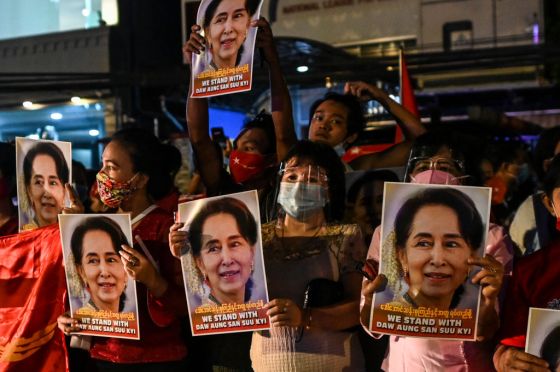
Ye Aung Thu—AFP/ Getty ImagesSupporters of the National League for Democracy (NLD) party hold posters with the image of Myanmar state counsellor Aung San Suu Kyi as supporters celebrate in front of the party’s headquarters in Yangon on November 9, 2020, as NLD officials said they were confident of a landslide victory in the weekend’s election.
On Jan. 29, the country’s election commission rejected allegations by the military that the election was fraudulent.
The same day, several Western diplomatic missions, including the U.S, issued a statement urging “the military, and all other parties in the country, to adhere to democratic norms.”
Joint Statement issued by the U.S. Embassy and other diplomatic missions in Myanmar: pic.twitter.com/kTEYwxqK2t
Suu Kyi won a Nobel Peace Prize in 1991 for her non-violent resistance against the military dictatorship that kept her under house arrest for 15 years. But more recently, she faced international scorn for her response to a violent crackdown by security forces against the Rohingya, a mostly Muslim ethnic minority. U.N. investigators determined that the violent campaign of arson, rape and murder was carried out with genocidal intent. But Suu Kyi has publicly rejected accusations that the military waged a genocidal campaign against the Rohingya.